Events

- This event has passed.
Ph.D. in Scientific Computing Student Seminars
February 25, 2025 @ 12:00 pm - 1:00 pm
Venue: 4th floor conference room, Green Ct.
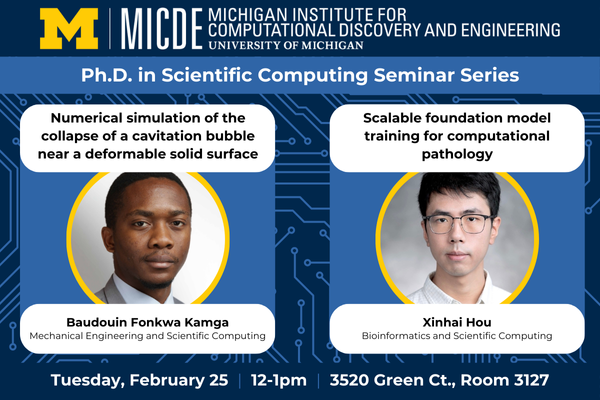
The MICDE PhD Student Seminar Series showcases the research of students in the Ph.D. in Scientific Computing. These events are open to the public, but we request that all who plan to attend register in advance. If you have any questions, please email [email protected].
Register to attend
Numerical simulation of the collapse of a cavitation bubble near a deformable solid surface
The exact mechanisms leading to the permanent deformation of solid surfaces, following a cavitation event, are still unclear. Specifically, the relationship between the characteristics of a given cavitation bubble and the shape of the resulting pit is unknown. In this study, we numerically investigate the collapse of a single cavitation bubble near a solid surface, with the objective of characterizing how the pit shape (height and depth) changes with the bubble initial radius, its distance from the solid and the initial pressure difference at the bubble interface. To this end, we implement a diffuse interface method for the interaction of multiple compressible fluids and hyperelastic solids in an Eulerian frame of reference. This method numerically solves the evolution equations of mass, momentum, energy as well as volume fractions of each material and of the mixture. The model is closed by splitting the internal energy of each material into hydrodynamic and elastic contributions, with appropriate equations of state. A set of evolution equations of local cobasis, with a plastic source term, are used to compute the elastic Finger tensor, which is needed to obtain the elastic energy and the deviatoric stress. We additionally provide improvements to the numerical method to preserve interface conditions. The proposed method allows to elucidate some of the mechanisms of cavitation pitting.
Baudouin Fonkwa Kamga, Mechanical Engineering and Scientific Computing
Baudouin is a 4th year PhD student in the department of Mechanical Engineering, under the supervision of Eric Johnsen. His research combines the theoretical study of cavitation in viscoelastic medium and the development of numerical methods for multimaterial compressible flows.
Scalable foundation model training for computational pathology
Scalable and efficient foundation model training is critical for advancing computational pathology. In this talk, we present a two-stage self-supervised pipeline for whole slide image (WSI) analysis. First, HiDisc leverages the inherent patient–slide–patch hierarchy to learn robust visual representations efficiently without relying on heavy data augmentation, outperforming existing methods in cancer diagnosis and genetic mutation prediction. Building on these high-quality patch-level features, our second stage, Slide Pre-trained Transformers (SPT), treats WSI patches as tokens and integrates data transformation strategies from both language and vision models to capture the rich morphological diversity of gigapixel images. Together, these methods offer a scalable, efficient framework for training foundation models that drive robust performance across a range of diagnostic tasks.
Xinhai Hou, Bioinformatics and Scientific Computing
Xinhai Hou is a PhD candidate in the department of computational medicine and bioinformatics. His research focuses on self-supervised learning, computer vision, and multimodal machine learning, with a particular emphasis on real-world applications such as AI in healthcare and medicine.