Catalyst Grants
The MICDE Catalyst Grants accelerate bold computational research that integrates modeling, simulation, AI, data-driven discovery, and HPC to tackle emerging scientific and engineering challenges.
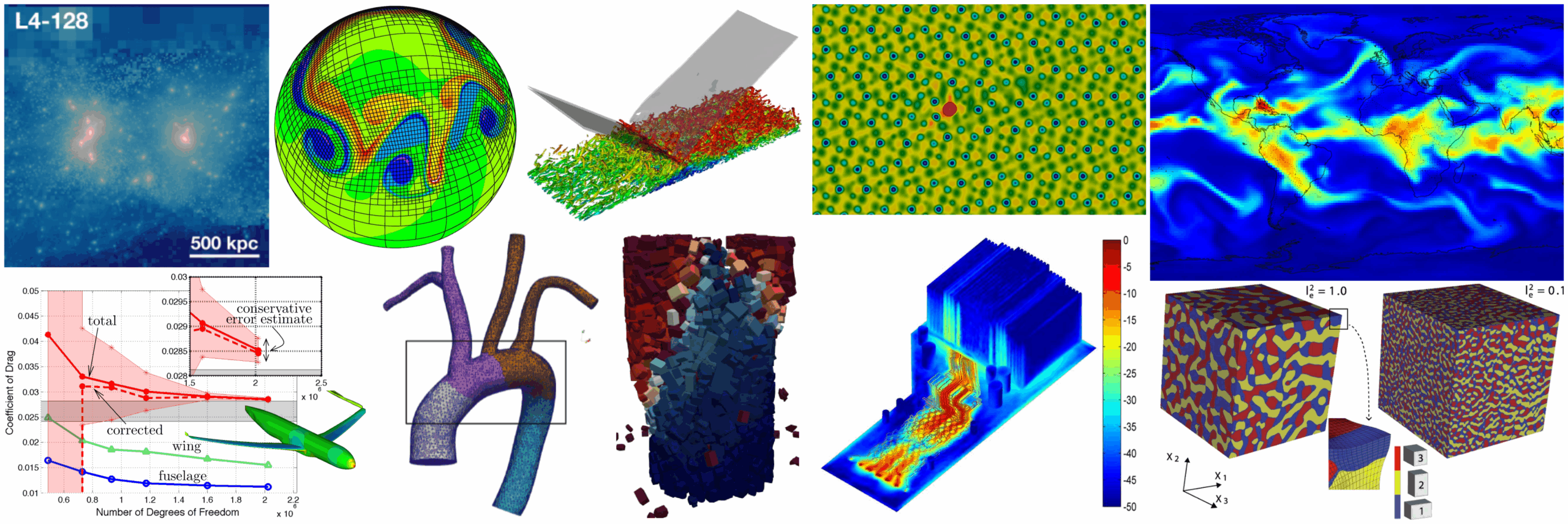
CALL FOR 2025 MICDE CATALYST GRANTS
The Michigan Institute for Computational Discovery and Engineering (MICDE) seeks proposals for innovative research projects that involve computational modeling, simulation, algorithms, and AI to accelerate scientific discovery and engineering innovation across disciplines. The program aims to spark new interdisciplinary collaborations and strengthen teams preparing to compete for external funding.
Overview
The 2025 call follows a tiered Catalyst Grants model that balances exploratory research with proposal-ready projects. Of interest are projects that combine elements of mathematics, computer science, and domain sciences, including but not limited to:
- Novel algorithms, modeling frameworks, or data-driven discovery methods
- Computational applications in engineering, medicine, and physical and life sciences
- Scalable and efficient approaches leveraging high-performance computing or AI
- Foundational tools and frameworks for next-generation scientific computing
Projects that do not involve science or engineering applications will be out of scope. Here you can find more information on the previously funded Catalyst Grants: https://micde.umich.edu/
For more information, please watch the 2025 MICDE Catalyst Grant Information Session recording.
Project Types
MICDE expects to fund one-year projects in two categories:
- Exploratory projects (up to 4 awards at $50,000 each): Bold, early-stage ideas that can open new scientific directions or novel methodological approaches.
These projects aim to establish feasibility, generate preliminary results, or explore emerging computational approaches that position the team to pursue external support within the following cycle.
- Readiness projects (up to 3 awards at $100,000 each): Strong ideas that can reach a competitive stage for external support.
These projects should have a well-defined research direction and a concrete plan for proposal submission during the award period, with MICDE funding enabling the final development of results, data, or partnerships needed for a successful grant application.
Priority will be given to projects demonstrating novelty, depth of computational science, broad scientific impact, and potential for external funding.
How to Apply
Letter of Intent (LOI)
Deadline: December 8, 2025, 11:59 p.m. E.T.
Submission: All PIs have now been notified of the outcome of their LOI submissions!
Full Proposals (by invitation only)
Deadline: March 31, 2026, 11:59 p.m. E.T.
Submission: Please visit https://micde.infoready4.com/
The full-proposal should include:
- 6-page narrative that includes:
- Project description
- Plans for follow-up funding
- Plans for leveraging of MICDE resources
- Personnel
- References (no page limit)
- 2-page NSF or NIH-style CV for PI and co-PIs
- Current and Pending support for PI and co-PIs
- Budget and budget justification (template included in InfoReady)
In the application, PIs should also include 2-3 suggested internal reviewers (U-M faculty), and 2-3 keywords.
For more details, please see the recording of the information session: https://www.youtube.com/watch?v=J59vs588D5w&t=2s
Questions should be directed to MICDE Managing Director Vancho Kocevski ([email protected]).
Who May Apply
PIs and co-PIs must be tenure and tenure-track faculty at the University of Michigan. Research scientists may participate as co-Is on a project.
An individual may participate as PI or co-PI on only one proposal. Priority will be given to PIs who have not received prior MICDE Catalyst Grants.
Budget and Justification
- Exploratory projects: up to $50,000
- Readiness projects: up to $100,000
- Project time span: 1 Year
- Allowable expenses include graduate student/postdoc salaries, PI/co-PI summer salary, travel, and computing costs.
- At least 80% of the funds should support graduate students or postdocs.
- Indirect costs will not be levied, and no cost-sharing is required.
- Projects are expected to begin by Summer 2026.
Review Criteria
- Relevance: Is computational science central to the project?
- Novelty: Is the proposed work sufficiently novel, relative to the field, rather than an incremental extension of existing work?
- Potential for external funding: Is there a plan for specific external funding agencies to be approached as an outcome of the proposed project, and a justification for why those agencies may find the work compelling?
- Preliminary Results: Have the ideas being proposed demonstrated a likelihood of success?
- Broader engagement: Is this an area that may attract other researchers at U-M and grow into a larger, interdisciplinary effort?
FAQ
Can research scientists or research professors serve as PIs or co-PIs?
Unfortunately no, only tenure and tenure-track faculty are eligible to apply as PIs or co-PIs. Research scientists can participate as co-Is on a project.
Are faculty from U-M’s three campuses eligible to participate?
Yes. Faculty from the Ann Arbor, Dearborn, and Flint campuses are eligible to serve as PIs or co-PIs on a project.
Am I eligible to apply as a PI, although I have a visiting position, and I am selected to officially start in the summer of next year?
Yes, provided that your project start date is no earlier than your official appointment start date.
Can a faculty member participate in more than one proposal?
No. An individual may serve as PI or co-PI on only one proposal per call.
Do PIs need to be MICDE-affiliated faculty?
No. Affiliation with MICDE is not required.
Can a proposal have a single PI?
Yes. Collaborative proposals are encouraged but not required.
Do projects need to include collaborators from computer science, mathematics, or cyberinfrastructure?
No, but interdisciplinary teams that combine computational and domain expertise are encouraged.
Does the project have to include both modeling and AI components?
No. Projects may focus on modeling, simulation, algorithms, or AI for science individually, or combine them as appropriate to the research goals.
Would purely methodological work without a specific science or engineering application qualify?
Probably not. Projects must demonstrate relevance to a scientific or engineering domain.
Are innovative applications of existing computational methods acceptable?
Yes. Both new methods and creative applications of existing approaches are sought.
Can a project primarily focused on software or tool development apply?
Yes, if the work advances computational methods or directly enables new scientific capabilities.
Is software development required as an output?
No, software is not expected as an output of the project, but open-source software, tools, or datasets are welcome outcomes.
How detailed should the plan for external funding be in the LOI?
It should identify one or more specific funding opportunities and explain how the Catalyst project will strengthen the team’s readiness to compete.
Can we request feedback if our LOI is not invited for a full proposal?
Yes, applicants may request summary feedback after notifications are sent.
Can project funds be used for experimental or lab analyses?
Data analysis is acceptable, but direct experimental costs are not supported.
Can funds be used for conference travel to present results?
Yes, reasonable travel to disseminate project outcomes or develop collaborations is allowed.
Can we pay undergraduate researchers from the grant?
Yes, but this should be a minor component; at least 80% of funds must support graduate students or postdocs.
Can we include subawards?
No. All funds must remain within U-M accounts.
Can funds be carried over beyond one year?
Extensions may be considered on a case-by-case basis, with a possible one-year extension. However, teams are strongly encouraged to complete the work within one year.
When will funding decisions be announced?
Invited LOIs will be announced in January 2026, and awarded proposals are expected to be announced in May 2026.
When must projects start?
All projects should begin by Summer 2026 to ensure timely progress.
What are the expectations for the projects?
Teams must outline a plan to submit one or more external grant proposals within the year. The readiness project teams will also be required to provide confirmation of submission and a short project narrative for the MICDE Magazine.