
In 2006, Rona Oran traveled to Türkiye with her department at Tel Aviv University to watch a total solar eclipse. As a master’s student in space physics, she found the experience fascinating and it helped change the trajectory of her career.
“I became very excited about the lavish structure of the corona and wondered, ‘How can we understand something so spectacular and complex?’” Oran said. “The University of Michigan had a group that modeled it, so I moved to U-M to study the Sun’s corona and the solar wind using observations and numerical models.”
Oran became a Ph.D. student in space science and scientific computing at the University of Michigan, where she studied space plasmas and the interaction of these plasmas with planetary bodies. There, she developed computational models of the solar corona and solar wind.
“Facing the challenge of modeling this system using complex computational frameworks, without having a deep understanding of how those computational tools work, was like being an astronomer who uses a telescope but does not understand how the lenses focus light,” Oran said. “Numerical modeling was an amazing tool and I really wanted to understand what it can and cannot do so we could interpret results and make realistic predictions. So I joined the Ph.D. in Scientific Computing program at U-M and that turned out to be one of my best career decisions. It provided a solid foundation. I wasn’t just given a tool with instructions on how to use it. I learned to truly understand its advantages and limitations.”
Oran’s work modeling the corona is critical because of its major technological implications. When the solar corona and solar wind undergo large changes that reach Earth’s magnetosphere, they can cause geomagnetic storms that disrupt power grids, satellites and telecommunications, as well as pose serious risks to astronaut safety.
The U.S. government has invested heavily in space weather models that Oran helped develop at U-M with funding from the Center for Space Environment Modeling, led by Tamas Gombosi, Konstantin I. Gringauz Distinguished University Professor of Space Science. These models are now part of simulation tools used by NASA and NOAA to predict space weather and continue to be developed and improved by future generations of students.
After leaving U-M, Oran conducted her postdoctoral research at the Massachusetts Institute of Technology (MIT). There, her research shifted to exploring processes that occurred four billion years ago on the Moon.
Oran used simulations to study how meteorite impacts could release plasma and potentially magnetize parts of the Moon. Although the Moon does not have a magnetic field today, Apollo astronauts returned magnetized rocks. Oran examined long-standing theories about whether the Moon may once have had a weak magnetic field or whether impact-generated plasma could explain the magnetization found in the Apollo samples. While scientists had debated the question for decades, the necessary computational plasma tools did not yet exist. Oran adapted the plasma simulation framework she worked with at U-M to address the unique processes involved in impact plasmas and planetary science, using tools initially developed for space weather.
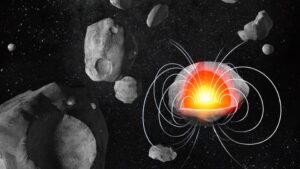
The metal asteroid 16 Psyche may have a strong remnant magnetic field.
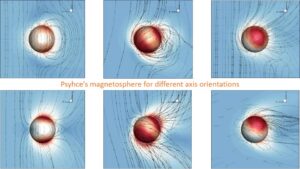
16 Psyche’s magnetosphere for different axis orientations.
Continuing this research at MIT, Oran became the principal investigator on a NASA Solar System Workings program project. There, she led an international team of scientists investigating how the crustal magnetic fields of the Moon and Mercury were formed. Her scientific computing expertise was critical for building the team and combining different numerical tools from very different fields: plasma simulations, impact-shock simulations of crater formation and inversion techniques for spacecraft magnetic-field measurements. Her team made major advances in determining whether impacts on these bodies could have enhanced their global fields and created strong localized magnetization.
This led to the discovery that while impacts themselves could not have magnetized the Moon, they could explain some of the more intense magnetization found by Apollo astronauts, magnetization that could not be explained by a native lunar magnetic field alone. This finding helped reconcile a decades-long puzzle and led to several high-profile publications, shifting the trajectory of future studies.
Her work is also critical for better understanding how solar wind interferes with measuring the magnetic field coming from a planetary body. Spacecraft carry magnetic-field sensors to distinguish which readings come from solar wind and which come from the planet being investigated. These deep-space missions require more precise interpretation of magnetic-field measurements than typical space weather modeling aimed at protecting satellites.
Oran tackled these challenges while serving as the Magnetometry Investigation Scientist for NASA’s Psyche mission through 2026, leading the development of plasma models of the asteroid 16 Psyche. These models were pivotal to analyzing mission scenarios related to detecting the asteroid’s magnetic field, likely the first such detection around an asteroid. Unlike the large-scale simulations she performed for the Sun and the Moon, simulating asteroidal magnetic fields led her to adopt a more advanced computational framework capable of simulating plasmas at much smaller scales.
She used these advanced simulations to guide mission planning with NASA stakeholders and to design the Magnetometry Investigation data pipeline that could process raw mission data and convert it into scientific insights, including 3D reconstructions of the magnetic field around the asteroid. This helped the Psyche team, led by Prof. Lindy Elkins-Tanton at the University of California, Berkeley, and the Magnetometry Investigation team, led by Prof. Benjamin Weiss at MIT, determine whether the field originates from the asteroid or from interplanetary space and trace its history.
“Changes in 16 Psyche’s magnetosphere as a result of a solar wind flowing around it.” Through her work, Oran explores how magnetic fields affect planetary habitability and atmospheric retention. Mars lost both its magnetic field and much of its atmosphere, while Venus lacks a magnetic field but retains a dense atmosphere. These contrasts present the kind of puzzle she aims to investigate by combining established computational tools with new ones. Understanding atmospheric plasma dynamics through simulation helps scientists explore what changes Earth may undergo millions of years from now, including whether the planet may lose atmosphere as its magnetic field changes or decays.
Oran credits her scientific computing training at U-M, along with interdisciplinary courses in aerospace engineering, mathematics and computer science, with making her more fearless about venturing into new areas of research, constructing and validating computational models and leading interdisciplinary teams.
“It is critical to create computational tools that solve equations grounded in the laws of nature. Understanding these fundamentals has served me very well throughout my career. These tools give you the power to research anything. Because of my training, I felt confident to lead a team of experts from many different fields,” Oran said.
“The scientific computing program gave me the skills to carefully construct and validate high-performance models, so that I and those I work with can have confidence when we use simulations to explore new mechanisms, systems and ideas.”
Looking ahead, Oran is exploring how AI can accelerate her work. For missions like Psyche, researchers need to separate magnetic fields carried by the solar wind from those that may originate from the planetary body or asteroid being studied. But traditional solar wind models were not designed to resolve environments as small as an asteroid. Because solar wind predictive simulations are expensive to run on thousands of processors at NASA centers, she is using previously collected models and data to drive AI-powered predictions of solar wind. Through Schmidt Sciences programs, led by Dr. Catherin Bowman at Arizona State University, she is also giving students opportunities to apply new AI approaches to the kinds of numerical models she learned more than a decade earlier at U-M.
“With AI, it is now easier to write code,” Oran said. “But scientific computing is still critical because it helps you understand the tools. When you solve a problem that nobody has solved before, you can trust the results because you understand the sources of uncertainty and margin of error. That’s what U-M gave me. Not just a tool, but the confidence to know when I’ve discovered something real.”