

As a freshman at Alma College in central Michigan, Charles Brooks worked as a quality control chemist in a petroleum refinery. Growing up in the 1960s, he was both curious and inclined to push boundaries. One afternoon, alone in the refinery laboratory, Brooks discovered just how dangerous chemistry experimentation could be.
“That was when I realized the bottles of chemicals are up on shelves with caps on them for a reason,” said Brooks. “People aren’t supposed to mess with them, so I’m not going to anymore. I decided I’d become a theorist. That was my turning point.”
A central aim of his research as the Warner-Lambert/Parke-Davis Professor of Chemistry and Cyrus Levinthal Distinguished University Professor of Chemistry and Biophysics at the University of Michigan focuses on accelerating and improving therapeutic drug discovery. Drawing on his PhD training in non-equilibrium statistical mechanics at Purdue University, Brooks developed ideas that became the framework for efficiently identifying molecules effective against biological targets, such as viruses and misfolded proteins.
Traditionally, scientists have used a method known as “computational alchemy” to compare how two molecules interact with a biological target to identify which best interacts with the biological receptor. This “alchemy” involves gradually transforming molecule A into molecule B through computer simulation using a variable called lambda, which acts as a dial that controls the transformation. To achieve accurate results, researchers run separate simulations at many fixed lambda values. For example, if the total number of lambda values is m and data is needed for n different pairs of molecules, n*m separate simulations must be run. This can be costly regarding both time and computing power.
Multisite lambda dynamics, a method developed by Brooks and his colleagues, accelerates this process by allowing lambda to change dynamically during the simulation, rather than remain fixed. Instead of comparing molecules one after another, the simulation can automatically shift between all n molecules (A1, A2, …, An) as the target fluctuates, allowing researchers to measure how each molecule binds more efficiently by letting the system explore all potential binding partners simultaneously. The “multisite” capability extends this dynamic switching across multiple chemical attachment points (substituents). If a drug molecule has three different sites where chemical groups can attach, all possible combinations can be explored at once. This speeds up the process dramatically, sometimes up to a thousand times faster, making it possible to search through significantly more potential therapeutic drug molecules in much less time. Brooks’ team is exploring additional machine learning approaches to further improve this process using AI.
“Experimentation is like steps on the stairs,” Brooks said. “Computational modeling can provide you with an elevator to move you along more quickly. Efficiency is crucial for increasing the overall process of drug discovery.”
Brooks completed his postdoctoral research at Harvard University with Martin Karplus in 1985. Karplus went on to win the Nobel Prize in chemistry in 2013 for research similar to the work Brooks was carrying out in his laboratory. At that time, biomolecular simulations were just emerging, and computation was not yet a standard tool in fields like chemistry and biophysics. Proteins were widely viewed as static structures. Realizing that proteins fluctuate was a transformative insight that emerged from this work and contributed to Karplus’s Nobel recognition. Today, the understanding that molecular motion is central to biomolecular function is foundational for researchers studying proteins, nucleic acids and molecular interactions at the atomic level.
One of the key outcomes of the work carried out by the Harvard group was a large software package that enabled the simulation and study of the dynamic behavior of biological molecules such as proteins and nucleic acids, as well as the interactions of these systems with small molecules. Brooks has continued to lead the development of this software throughout his career. Since his postdoctoral work, he has been involved in large-scale computing aimed at exploring biomolecular dynamics.
Brooks first became involved in large-scale computing in 1985 as a faculty member at Carnegie Mellon University, following the establishment of the Pittsburgh Supercomputing Center. In partnership with the National Science Foundation (NSF), he played a pivotal role in incorporating biomolecular computing into the center’s initiatives. In 2008, he joined U-M, where he established and maintains a powerful computing cluster that serves as the main resource for his computational research.
Brooks applies his computational methods in collaborations with experimentalists like Alison Narayan, professor of chemistry, whose research focuses on the discovery of proteins capable of transforming small molecules into valuable therapeutics. To optimize the process, she uses directed evolution, an experimental approach where random changes are made to a protein’s genetic code, generating many new variants. Each variant is tested to see which performs best for the target reaction, a process that is repeated over several rounds. Typically, only one in every 10,000 proteins proves successful.
Brooks’ team saw an opportunity to enhance this process. Azam Hussain, a PhD student in Brooks’ lab, used AlphaFold2, a powerful Al-based program that predicts three-dimensional protein structures from their amino acid sequences. Using ancestral proteins – reconstructed from earlier in evolution, which tend to be more stable and can tolerate more changes, Hussain modeled the 3D structures. He then used computational docking simulations to predict how well different small molecules would fit into the proteins’ active sites. This process helped the team estimate which protein variants would most likely produce the desired product.
Building on these predictions, Hussain combined experimental data from Narayan’s lab with machine learning models to identify which amino acids in the proteins were essential to change. This allowed the team to computationally design new protein variants, predict their structures and simulate how well they would work. Using a process known as resurrection, the redesigned ancestral proteins were created in the laboratory. Over the past year, Hussain has been producing and testing these proteins to see if the predictions hold up in real experiments. The results have been very encouraging
“Based on the data we’ve collected, the success rate is near 1 in 10 as opposed to one in 10,000,” Brooks said. “This was another place where we have used existing machine learning frameworks to advance this question of how we find bio-catalysts in a better manner.”
This dramatic improvement demonstrates how Brooks and his students integrate machine learning to transform drug discovery. By bringing his lifelong curiosity to every collaboration, he is making the process faster and more efficient.
“I continue to love to ask questions and explore the answers myself or through work with my students. An important question that I try to embed in all of my students’ thinking is, when you have something that works well, ask yourself: ‘How am I going to break it?’ It is when you break it that you usually learn the most.”
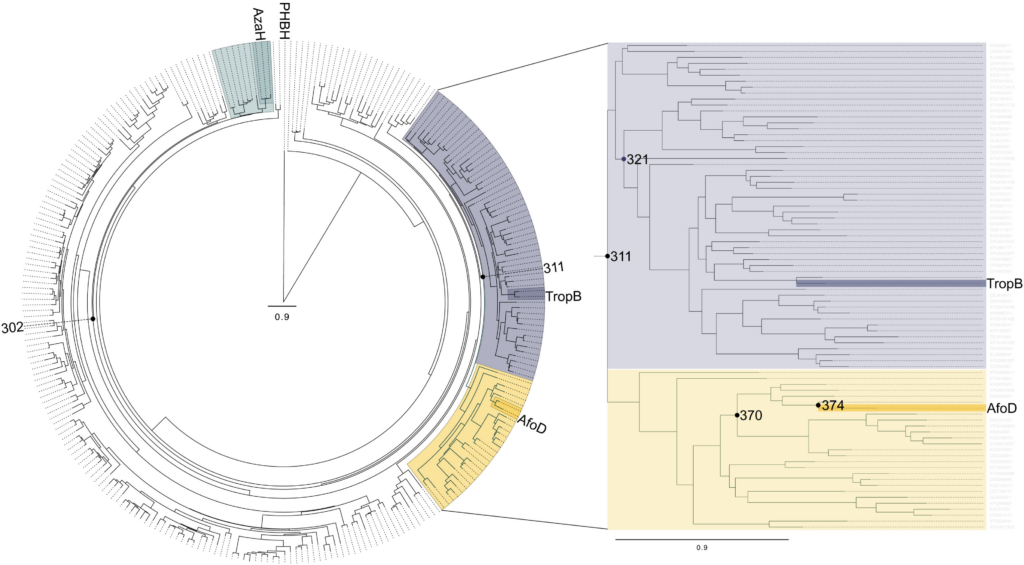
Phylogenetic tree of the flavin-dependent monooxygenases, shown in a polar tree layout and a zoom-in focus on the TropB and AfoD clades. The ancestral nodes (sequences) in the tree are numbered from 278 to 553. Source: https://www.pnas.org/doi/full/10.1073/pnas.2218248120
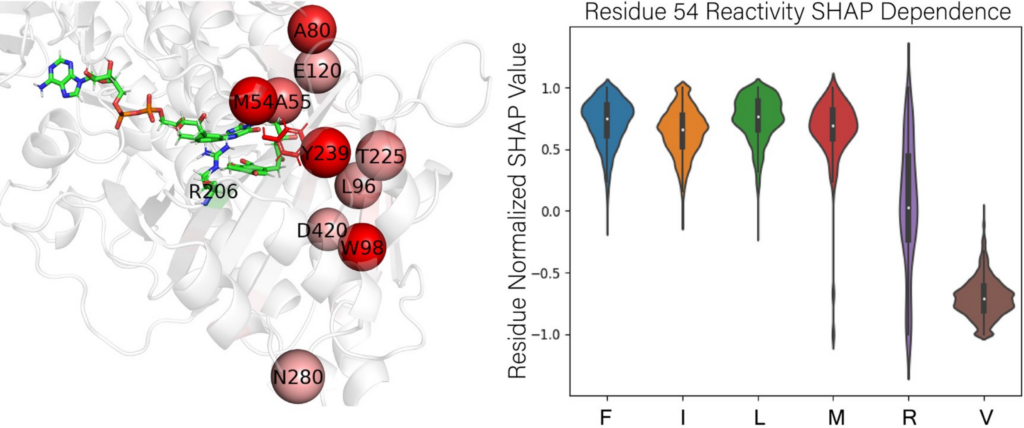
Top 10 residues by mean absolute normalized SHapley Additive exPlanations (SHAP) value across all generated folds of all models for prediction of reactivity. (right) SHAP dependence plot of residue 54 across all folds of all models for the full sequence library for the prediction of reactivity.
Reprinted in part with permission from https://academic.oup.com/bioinformatics/article/40/1/btae002/7513688. Copyright 2024 American Chemical Society.
Charles L. Brooks III Festschrift: Biomolecular Dynamics and Interactions
Charles L. Brooks III has profoundly shaped generations of biophysicists. The papers by his colleagues presented in this Festschrift span a wide range of topics, including biomolecular dynamics, protein interactions, ligand studies, lipid membranes, as well as developments in force fields. This breadth illustrates his role in providing foundations for research that has branched off in many different directions. In addition, his close collaboration with experimentalists to ensure that computational efforts remain directly relevant to laboratory findings has had far-reaching influence in the community.
https://pubs.acs.org/page/jpcbfk/vsi/charles-1-brooks-festschrift