

Download the PDF version from here.
Hosted by the University of Michigan on the Ann Arbor campus, the Los Alamos National Laboratory (LANL) Michigan Strategic Partnership and Accelerated Research Collaboration (SPARC) was established in 2024. This joint effort centers on advanced high‑performance computing, artificial intelligence and large‑scale science to develop increasingly sophisticated modeling techniques that address critical challenges facing society.
What makes the U-M/LANL partnership unique is its integration of a major national laboratory directly into U‑M’s research ecosystem. SPARC also highlights advances in multiscale simulation, accelerated numerical methods and scientific machine learning. These advances matter far beyond any single application. Scientific computing has emerged as a foundational pillar of modern discovery, complementing theory and experiment. Methods developed within SPARC for one class of problem routinely transfer to others, which is part of why investments in foundational computational capability yield outsized returns across science and engineering.
One of the key efforts in this collaboration is a Laboratory Directed Research and Development (LDRD) project, “Bridging kinetic to continuum scales in laboratory plasmas,” led by Jonah Miller, an astrophysicist and computational physicist at LANL, co-located in Ann Arbor. Funded at $6 million over 3 years, the project brings together teams from LANL and U-M, including 6 researchers in the Michigan Institute for Computational Discovery and Engineering (MICDE).
The goal of the project is to uncover how matter transitions into the plasma state. Plasmas, the fourth state of matter, make up more than 99 percent of the visible universe and turbulent plasma dynamics govern an extraordinary range of phenomena: the formation of stars and galaxies, the accretion flows around black holes, the neutron-star mergers that forge the heavy elements in our own bodies and the solar storms that threaten satellites and power grids here on Earth. Understanding turbulent plasma behavior is also critical to unlocking nuclear fusion’s potential as a nearly limitless source of clean energy. Fusion reactions use hydrogen, the universe’s most abundant element, without producing the long-lived radioactive waste associated with today’s nuclear fission power. By improving our understanding of plasma dynamics, this project helps move fusion energy toward practical reality.
Miller and his team collaborate with the Michigan Accelerator for Inductive Z‑pinch Experiments Facility (MAIZE), drawing on existing data from the facility. MAIZE, led by Ryan McBride, a core member of Miller’s team, is a versatile pulsed-power system housed in the Department of Nuclear Engineering and Radiological Sciences, that is capable of a wide range of experiments. In one such experiment, a powerful electrical “flash” machine sends a short, intense current through an x-pinch wire array of fine copper wires spaced approximately 1 millimeter apart. Electromagnetic forces draw them together, creating a plasma channel of free-flowing charged particles. McBride’s group continues to run experiments at the facility.
“This project would not be possible without both sides of the collaboration,” Miller said. “Los Alamos brings expertise in the applied physics required to model these systems and build the code. But that alone is not enough. It takes novel numerical methods and creative approaches to accelerate computations that MICDE researchers provide. The University of Michigan also brings the MAIZE pulsed-power lab and faculty who think about problems in fresh, innovative ways. That combination of experience and perspective is what this project is built on and that’s why we’re so excited about this collaboration.”
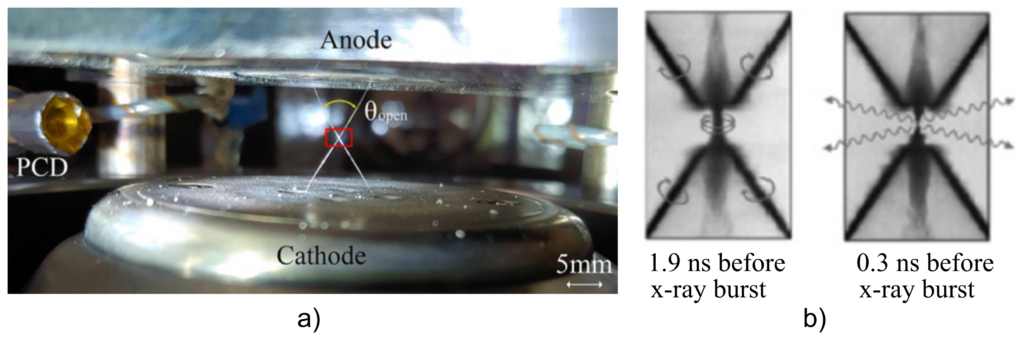
a) An X-pinch configured on the UM MAIZE facility. b) Radiographs illustrating X-pinch process [S. A. Pikuz, et al. Plasma Physics Reports, 41(4):291–342, 2015.].
In these violent collisions, neutrinos are produced in large numbers. These subatomic particles barely interact with matter, often passing straight through stars and planets, which makes them difficult to detect. They also constantly shift among three forms: electron, muon and tau neutrinos, through a phenomenon known as neutrino oscillation. Modeling these oscillations is notoriously difficult but critical for understanding and accurately modeling the formation of heavy elements in these plasmas.
When Miller arrived at LANL, he saw that the same ideas relevant for modeling the plasma around a neutron-star merger are relevant for modeling the plasma in a laboratory, an overlap that allows him to work across multiple domains.
“One of the most exciting things happening in astronomy, particularly in the neutron-star merger world, is that people have come to recognize the importance of taking advantage of the vast separation of scales between important microscopic processes and the fluid dynamics governing the plasma,” Miller said. “We’re applying that same approach to fusion power experiments. Traditional computing can get you far, but if you really want to solve the unsolved problems, you have to be clever.”
During a fusion experiment, researchers cannot directly observe what happens inside the target. Instead, they infer what occurred from diagnostics such as radiographs, X-ray images and pinhole experiments in which fusion-produced neutrons pass through an aperture and are recorded on a screen. Because each diagnostic captures only part of the event, Miller uses simulations to reconstruct the full picture.
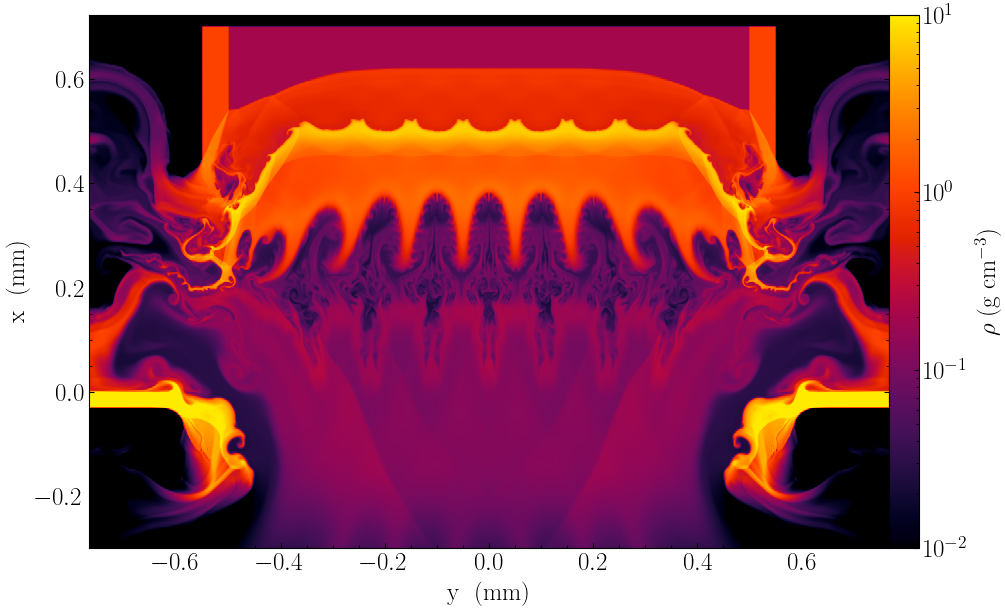
A simulation of a planar inertial confinement fusion relevant experiment in riot. Image from SPARC scientist Patrick Mullen.
Several advances have already emerged from the SPARC collaboration, and three are particularly important to Miller’s project. The LANL SPARC team has been developing a new supercomputer code called RIOT for modeling complex flows, allowing models to run significantly faster than previously possible at LANL. This speedup has the team energized because it opens new possibilities for tackling more challenging problems.
Miller has been collaborating with Alex Gorodetsky, associate professor of aerospace engineering at U-M, on a new approach to radiation transport that tracks the motion of light. This is critical because when materials are heated, they glow, and that emitted light carries energy that can alter the dynamics. Together, they have developed a method that, for realistic-scale problems, yields speedups of 100 times or more. These gains enable broader applications and are being applied to better model plasmas. The team also plans to extend the technique to the particles that make up plasma, an important next step for the research.
Will Taitano, a LANL scientist, has been developing a new mathematical formulation for tracking these phase transitions. These three ideas arose at about the same time, which Miller describes as serendipitous. The team plans to combine them and apply them to the project.
The SPARC collaboration is exploring AI and machine learning methods to make previously impossible simulations feasible and to shorten the design cycle for fusion experiments. Designing a fusion experiment is iterative. Researchers run a simulation, adjust the design and run the simulation again. Miller hopes to reduce the turnaround time from weeks to hours.
The collaboration is also exploring techniques that code core physics principles into AI models, such as the conservation of energy, that statistical methods might miss.
“We’ve never tried anything like this collaboration before,” Miller said. “Los Alamos is involved in many scientific endeavors, including fusion power research, power grid optimization for energy security, disease modeling, drug discovery and weather prediction. This collaboration is an opportunity to grow beyond that, combining with the energy and forward thinking of the university to attack the most complex problems. If we can broaden our scientific focus by collaborating more effectively, we can make the world a better place. It’s been a very exciting and fruitful partnership so far.”