Events

- This event has passed.
Ph.D. in Scientific Computing Seminar Series
October 7, 2025 @ 11:45 am - 12:45 pm
Venue: North Quad – 2185
The MICDE PhD Student Seminar Series showcases the research of students in the Ph.D. in Scientific Computing. Lunch will be served. These events are open to the public, but we request that all who plan to attend register in advance. Planned sessions will be canceled if no one signs up to present, and registered attendees will be notified.
If you have any questions, please email [email protected].
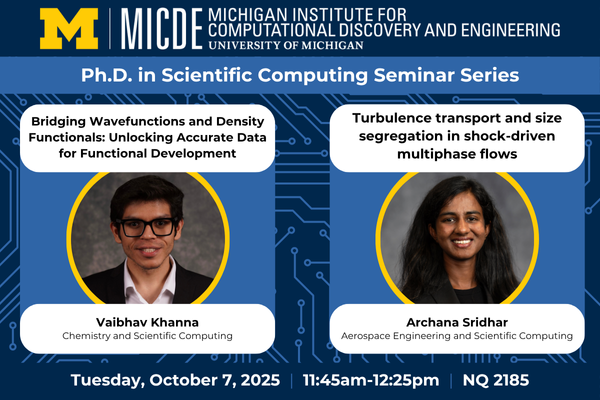
Bridging Wavefunctions and Density Functionals: Unlocking Accurate Data for Functional Development
Density Functional Theory (DFT) is one of the most widely used electronic structure methods in chemistry, physics, and materials science, striking a balance between accuracy and computational efficiency. However, its accuracy is fundamentally limited by the choice of the exchange-correlation (XC) functional, which remains an approximation in all practical applications. A key shortcoming of existing functionals is their failure to reproduce critical features of the exact XC potential, such as the asymptotic -1/r decay and the step at integer electron transitions—features essential for correctly describing ionization energies, band gaps, and dissociation limits. In this work, we take a data-driven approach to improving DFT by generating XC potentials from full configuration interaction (FCI) calculations. Using a large Slater basis, we systematically recover key features of the exact XC potential across atomic systems and analyze their behavior. Additionally, we compute exchange-correlation energy densities via an aufbau path integral, ensuring consistency with total XC energy values from FCI. These highly accurate DFT quantities establish a benchmark for diagnosing errors in existing functionals and guiding the development of new approximations that incorporate wavefunction-level accuracy while retaining DFT’s efficiency.
Vaibhav Khanna (Chemistry and Scientific Computing)
Vaibhav Khanna is a Ph.D. candidate in Chemistry and Scientific Computing at the University of Michigan, where he works under the supervision of Prof. Paul Zimmerman. His research focuses on developing improved density functionals that bridge the gap between highly accurate but computationally expensive wavefunction methods and the efficiency of the popular Density Functional Theory (DFT). By incorporating wavefunction-level accuracy, his work aims to significantly improve the predictive power of DFT, a widely used computational method in chemistry, physics, and materials science.
Turbulence transport and size segregation of shock-driven multiphase flows
The phenomena of a shock-wave interacting with a particle suspension is observed in applications such as pulse detonation engines, volcanic eruptions, coal dust explosions and plume-surface interactions during spacecraft landings. Compressibility effects during these interactions give rise to complicated dynamics in the suspensions. While there has been a lot of effort and progress in modeling incompressible flows, much less work has been done in modeling the microscale physics in turbulent flows at finite Mach numbers. Particle-resolved numerical simulations of shock passing through monodisperse suspensions are used to guide the development of subgrid-scale models for turbulence transport. Turbulent kinetic energy (TKE) is found to contribute to a significant portion of the resolved kinetic energy. A two-equation model is proposed and implemented within a hyperbolic Eulerian-based two-fluid model. The model is found to be accurate across a wide range of volume fractions and Mach numbers. Additionally, to analyse particle dispersion and segregation in bidisperse suspensions with extreme diameter size ratios, a hybrid numerical framework is developed, combining an immersed boundary method for large particles with Lagrangian particle tracking of small particles.
Archana Sridhar (Aerospace Engineering and Scientific Computing)
Archana is a 5th year PhD student in the Aerospace Engineering department. She is a MICDE Fellow working with Dr. Jesse Capecelatro. Her focus is on computational fluid dynamics of multiphase compressible flows.