

For the millions of people living with Alzheimer’s disease, and many living with Parkinson’s, finding their way home can become an overwhelming challenge, even in their own familiar neighborhoods. This spatial disorientation, often called wandering, reflects a breakdown in the brain’s internal navigation system: a complex computational network that most of us rely on without realizing.
Omar Ahmed, associate professor of psychology at the University of Michigan, is working to understand how that system functions and why it fails. His lab combines experimental neuroscience with computational modeling and machine learning to identify the brain regions, neurons and calculations that allow humans and many other animals to orient themselves and navigate through the world.
Many species, including humans, navigate using a process termed dead reckoning, an internal sense of direction that continuously updates as we move, without reliance on external cues. A person standing on their street intuitively knows which direction their house is because the brain is constantly making that calculation.
Central to this process is the retrosplenial cortex, a region of the brain that appears fundamental for computing the angles that connect location A to location B. Damage to this region, whether from hemorrhages or glioblastoma, produces the same disorientation seen in patients with Alzheimer’s and Parkinson’s. In one case study, a person driving home was forced to pull over after realizing mid-highway that they had no idea which direction to proceed.
To understand the computations underlying navigation, Ahmed’s team first had to do extensive experimental work recording and characterizing every type of neuron in the retrosplenial cortex, including their inputs. What they found was unexpected. The region contains a unique class of neuron found nowhere else in the brain.
These uniquely small neurons fire constantly, making the retrosplenial cortex one of the most metabolically demanding regions in the human brain. This constant firing is likely due to the continuous calculations being run, which are critical to survival. A mouse in an open field that sees a predator’s shadow has less than one second to turn in the optimal direction and run for shelter. A wrong turn could be fatal. Ahmed believes this existential pressure is why these neurons demand such extraordinary metabolic resources.
Outside of the retrosplenial cortex, a separate class of neurons called head-direction cells encode which direction a person is pointing in the world, updating continuously as the head turns. The unique retrosplenial neurons are positioned to receive input from these head-direction cells through optimally positioned dendrites, the branch-like extensions that carry signals toward a nerve cell’s body.
Using computational modeling, Ahmed’s team predicted that the unique retrosplenial neurons could take the incoming head‑direction signal and determine its derivative over time, thus calculating angular velocity. In this way, the brain maintains a continuous, internal sense of orientation through multiple turns. This tracks not just which direction the head is facing, but where various markers are, such as the sun or home
To better understand why these neurons fail, Ahmed and his team are examining what a retrosplenial neuron looks like in a mouse model of Alzheimer’s. Physiologically, they appear nearly normal. The difference is a measurable decrease in the number of inputs coming from the head-direction cells.
“In Alzheimer’s, we often hear about amyloid plaques and tau tangles,” Ahmed said. “But these are just making synaptic connections worsen over time. At its core, Alzheimer’s disease is a synaptic deficit. That means that these neurons are getting fewer inputs from the head-direction cells. So the question becomes, how do we restore that?”
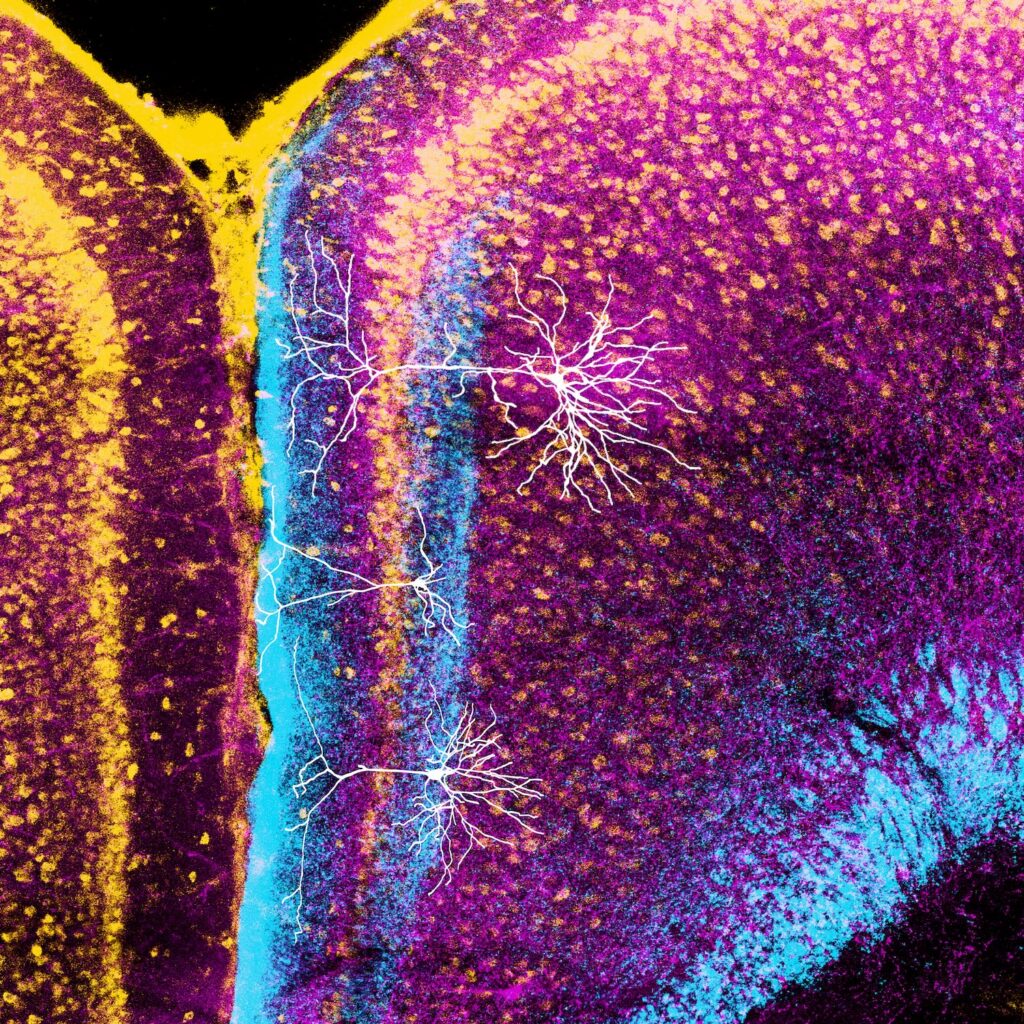
The retrosplenial cortex, a brain region critical for spatial orientation calculations. The small white neuron in the middle is the low rheobase cell identified by the Ahmed lab. The blue color shows inputs coming in to the retrosplenial cortex from the thalamic head direction cells. The blue inputs overlap with the dendrites (branches receiving and processing inputs) of the middle low rheobase cell, but not the other, more standard neurons shown above and below it. Thus, the low rheobase is ideally positioned to use this head direction information to compute spatial orientation related information.
That question led Ahmed’s lab to investigate whether psychedelic compounds might have the answer. Funded by the University of Michigan’s Eisenberg Family Depression Center and the National Institutes of Health, the lab is uncovering whether those compounds can reverse the navigational deficits seen in Alzheimer’s.
Psychedelic drugs have demonstrated clinical promise for treating major depression. In controlled clinical settings, using controlled doses, a single treatment can reduce symptoms for years by increasing the number of synaptic inputs in the prefrontal cortex.
Similarly, because Alzheimer’s is a synaptic deficit, Ahmed’s lab is exploring whether the same mechanism applies to the navigational deficit in Alzheimer’s.
When the brain is in the acute phase after the psychedelic drug is administered, Ahmed’s team has shown that neurons enter a state of decreased excitability, contrary to prior assumptions.
Just as physical exercise damages muscle fibers and the body responds by rebuilding them stronger, the brain detects this dampened excitability state and responds by building back more robust synaptic connections. This process is thought to be one reason why improvements from psychedelic treatment have been observed for years after a single session.
Ahmed’s team used machine-learning models, trained on just one second of real neuron data, to capture the full set of ion-channel conductances within that neuron. These models allowed them to simulate neuron behavior under conditions that would be practically impossible to test experimentally in real time. This ability to remove different factors and change ratios is critical because neurons are part of such a complex system.
“This is the brain saying, ‘Hey, that wasn’t active enough, so let’s put more synapses in,’” Ahmed said. “The brain is a homeostatic machine and wants to operate at a set point. So if you take it below that point, it’s going to find ways to fix that less active state. Using psychedelics in a temporary capacity can rescue synaptic activity in Alzheimer’s mouse models, and that could not have been understood without the computational model.”
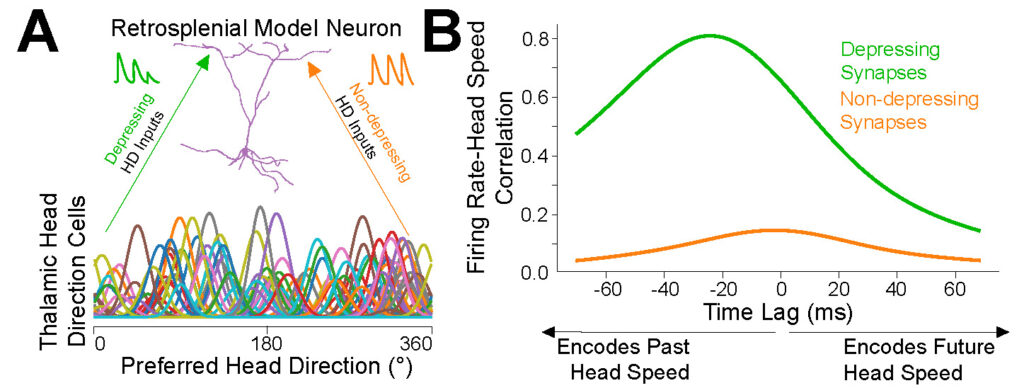
(A) A computational model of a retrosplenial low rheobase neuron receiving head direction inputs from many differentially tuned head direction cells. The inputs were modeled as either showing a phenomenon called short term depression (green; representing the experimental reality) or not showing this short term depression (orange; seen in many other synapses, but not this one) to understand the computational implications of synapses that show smaller and smaller responses when given rapidly repeating inputs, a phenomenon called short term synaptic depression.
(B) Cross-correlation between the model low rheobase neuron’s activity (firing rate) and experimentally observed head speed. The model with short term synaptic depression (green) is able to use the head direction input to calculate the animal’s head speed with high accuracy because the synaptic depression allows it to compute derivatives.
In one instance, a modeled neuron began firing chaotically after a psychedelic was administered. Assuming it was a modeling error, Ahmed’s team compared the results to experimental data and found the same chaotic firing. Without the model, his team would never have noticed the anomaly.
Ahmed’s work requires simultaneous collaboration with experimentalists and neurosurgeons collecting data from mice and donated human brains. That data must then all be analyzed computationally.
“It takes a village to answer any one question,” Ahmed said. “On our team, we have a very talented group of undergrads, grad students, technicians, postdocs and neurosurgeons and every single one is critical. We are all needed both in the lab and working on the computations, the transcriptomics and the human and mouse tissue. This work wouldn’t be possible without everyone.”
The team relies on transcriptomics, the analysis of RNA expressed by individual neurons, to essentially build a detailed readout of which genes each neuron is actively using. Each neuron expresses tens of thousands of genes, creating a detailed molecular profile made up of thousands of data points. When repeated across many neurons, this produces large datasets that can be analyzed using bioinformatics tools to identify patterns and group neurons into distinct types.
These groupings reveal how neurons differ in genetic activity, physiology and function. The RNA signature of one neuron type can be markedly different from another, reflecting distinct computational roles. By combining transcriptomics with experiments in brain slices, where individual neurons are stimulated and recorded, the team can directly link gene expression to functional behavior.
Transcriptomics can also be applied to donated human brain tissue, including from individuals who lived with Alzheimer’s disease. This allows researchers to compare gene expression patterns between healthy and diseased brains to identify specific molecular changes associated with degeneration.
The team then connects these findings back to mouse models, where they can test how specific gene changes affect neuronal computation. They record from hundreds to thousands of neurons in behaving animals as they perform navigational tasks in virtual environments. Specialized setups even allow researchers to rotate the animals at controlled speeds and directions, making it possible to measure how neural networks respond to changes in orientation.
Together, these approaches reveal how diverse neurons, each with distinct properties, work as a coordinated system to compute direction and guide navigation.
“There’s no better problem to solve than how the brain computes because the brain is who we are,” Ahmed said. “But it’s remarkably complex. AI may be inspired by the brain, but the brain still holds so many more beautiful things to discover. I want to understand the computations the brain uses and learn from the brain to make our algorithms better. That continues to be a key pursuit in our lab.”