
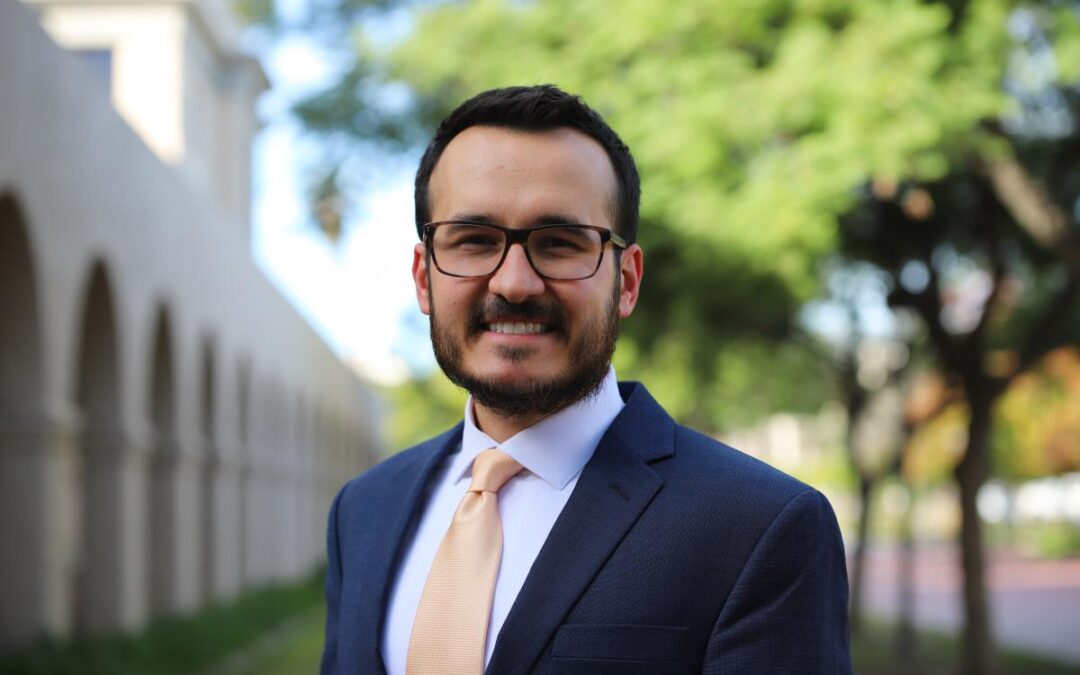
Michael J. Wadas has been named the recipient of the 2025 Andreas Acrivos Dissertation Award in Fluid Dynamics, presented annually by the American Physical Society to recognize the most outstanding doctoral thesis in fluid dynamics in the United States. Considered the highest honor for a PhD graduate in the field, the award acknowledges groundbreaking work that advances fundamental understanding and impacts multiple scientific frontiers. Wadas received his PhD in Mechanical Engineering from the University of Michigan in 2023.
Wadas’s dissertation, Hydrodynamics of Shocked Interfaces, conducted under the mentorship of Eric Johnsen, associate director of MICDE and professor of mechanical engineering, uncovers how shock waves interacting with density-stratified fluids generate self-propelling vortex rings and explores how these structures scale and destabilize under extreme conditions. His work explains long-observed but poorly understood phenomena in two high-impact domains: inertial confinement fusion (ICF) and supernova hydrodynamics.
Using a combination of theory, high-fidelity computation and experiment-informed modeling, Wadas has uncovered new physical mechanisms that govern how shock-accelerated interfaces behave and generate vortex structures. He demonstrated a technique for strengthening shock waves in dynamic-compression experiments. He also established a predictive scaling framework that shows how interfacial protrusions invert and shed self-propelling vortex rings, thus extending classical vortex-ring theory into compressible, variable-density regimes relevant to fusion capsules and astrophysical flows. His work further revealed how related vortex structures can destabilize due to vortex-core instability, offering a compelling hydrodynamic explanation for the “string-of-pearls” clumping observed in Supernova 1987A. Together, these advances provide scaling laws and stability predictions that enable far more predictive control of shock-driven mixing, a long-standing challenge in high-energy-density environments.
A distinctive theme of his work is the role of computation as a discovery engine. Wadas noted, “There is really no understanding like that which comes from observing something with one’s own eyes, making an approachable computational environment one of the most powerful learning tools.”
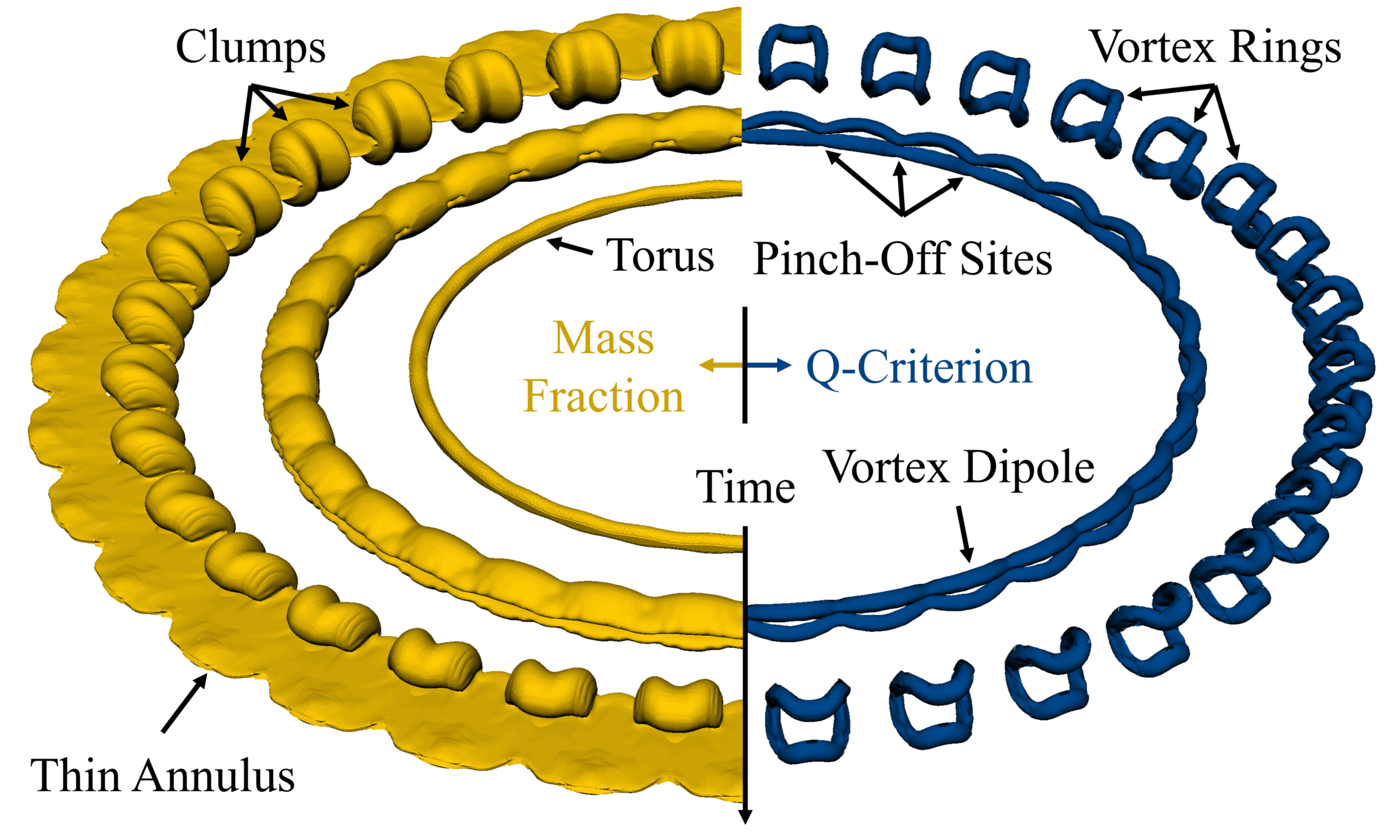
Isosurfaces of mass fraction (left) and Q-criterion (right) at increasing time, which increase with increasing radius. Source: https://doi.org/10.1103/PhysRevLett.132.111201
Looking back, Wadas credits the research community around him, especially the Scientific Computing and Flow Physics Laboratory and the Center for High Energy Density Laboratory Astrophysical Research (CHEDAR), for turning curiosity into discovery. Working closely with code developers, experimentalists and astrophysicists gave him the resources to rapidly test new theories and the confidence to explore bold connections. He described the University of Michigan as a place “where experts are willing to engage in highly cross-disciplinary ideas,” fostering a community dynamic that helped shape the direction and ambition of his thesis.