
$20M Center to Advance Intelligent Reasoning and Computational Science to Predict Complex Physics
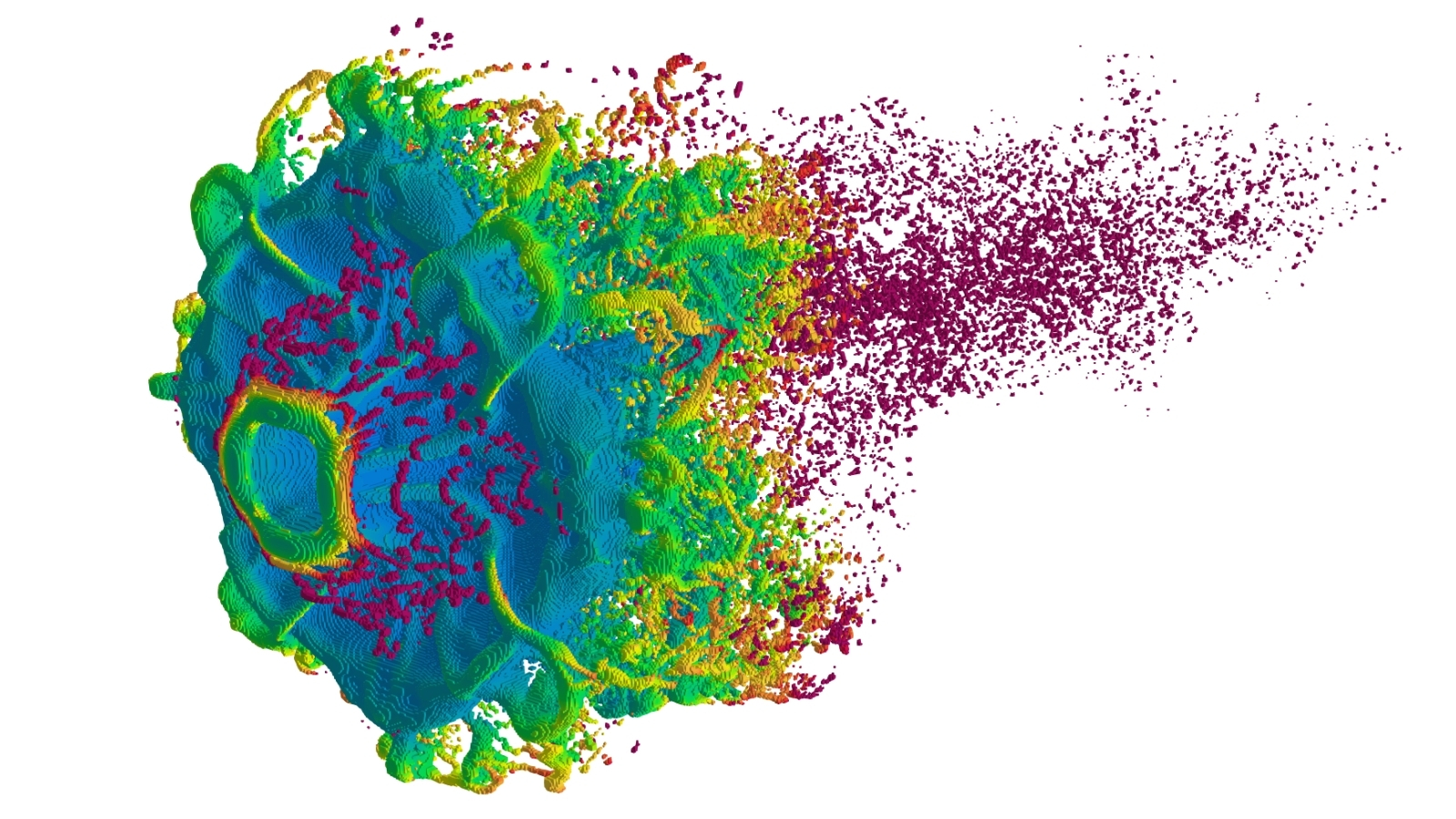
High resolution computation of a droplet interacting with a shock front. Photo Credit: Venkat Raman.
By Wendy Sutton
Office of the Vice President for Research
Under the leadership of Venkat Raman, James Arthur Nicholls Collegiate Professor of Engineering and professor of aerospace engineering and mechanical engineering the University of Michigan will establish an innovative center for computational science and AI.
The Center for Prediction, Reasoning & Intelligence for Multiphysics Exploration (C-PRIME), part of the Predictive Science Academic Alliance Program, is a five-year, $19.4 million initiative that underscores the national prominence of the Michigan Institute for Computational Discovery & Engineering (MICDE) and the University of Michigan.
The U.S. Department of Energy will provide approximately $17.5 million of the total funding, while U-M will contribute the remaining $1.9 million.
The goal of this center is to transform the ability to predict and understand complex, integrated systems by examining how small details can significantly impact larger patterns and behaviors across a range of operating conditions dominated by different physics. Its focus is on a device known as a rotating detonation combustor (RDC), a concept originally pioneered at U-M, and one that has recently seen a surge of interest in propulsion and energy generation applications.
RDCs also involve multiple physical processes and scales that pose challenges relevant to the DOE. By transforming the study of complex problems such as the evolution of materials and turbulence, the center aims to develop sophisticated autonomous AI agents.
These agents, using inner- and outer-loop algorithms, will drive computational frameworks to refine the interplay of physics, simulations, algorithms and computing infrastructure, significantly reducing the time from initial scientific inquiries to actionable predictive insights.
The center will be co-located within MICDE and will collaborate with the Strategic Partnership and Accelerated Research Collaboration (SPARC), which brings together Los Alamos National Lab staff scientists and U-M partners.
“This new center will collaborate extensively with MICDE,” said Eric Johnsen, director of the MICDE scientific computing Ph.D. program, professor of mechanical engineering, and co-director of C-PRIME. “Ph.D. students will have cutting-edge training in emerging technologies in computational science and AI. The opportunity to work directly with the SPARC team and our other national laboratory partners will add tremendous value to our students’ education.”
The overarching goal of C-PRIME is to create a “persistent computing machine,” which continuously runs calculations independent of human input. When needed, the team can consult the system like an oracle to ask questions on topics of interest, such as, “What is the efficiency of the engine if I make this design change?” The computer processes the question by combing through its accumulated knowledge base and either immediately returns an answer or conducts additional simulations before returning one.
C-PRIME aims to create this AI agent for physics simulations, while ensuring trustworthiness by minimizing or even eliminating hallucinations found in current-generation AI systems. The AI agent will be trained exclusively on fundamental physics principles that we trust, such as Newton’s laws. These principles serve as basic building blocks, or “primitives.” The system then uses these primitives to construct more complex ideas. By grounding the system in trusted primitives, researchers can have confidence in the accuracy of the data generated and the conclusions drawn.
“This technology is emerging at an unprecedented rate,” Raman said. “Typically, there is an incubation period that provides academia time to consider implications and policy. AI is advancing so rapidly that everything we do now can have a lasting impact. It’s important for U-M to have a voice in this progress so that we can act as stewards guiding its development. We are careful partners for this enterprise and want to help society for the public good. This means we must thoughtfully consider the implications of what we are doing. This center will allow us to do that.”
Once this approach is mastered for one engineering field, it can potentially be replicated for other disciplines. In theory, researchers could develop machines capable of independently exploring all engineering disciplines, building a trustworthy foundation with minimal mistakes for automating scientific discovery.
The project is divided into five research thrusts:
Excerpt by Kate McAlpine, College of Engineering
- Physics and data: This effort covers foundational physics, developing models and honing them with experiments that fill holes in the existing data, with a focus on how materials mix and react. Led by Eric Johnsen, center co-director, professor of mechanical engineering and director of the scientific computing Ph.D. program.
- Verification, validation and uncertainty quantification: With the goal of ensuring the accuracy and reliability of the computer models, this thrust digs into how assumptions and simplifications in the physics models affect predictions. Led by Alex Gorodetsky, associate professor of aerospace engineering.
- Exascale supercomputing architecture: This effort optimizes the models to take full advantage of powerful supercomputers and lays groundwork for building next-generation supercomputers optimized for AI. Led by Reetuparna Das, professor of computer science and engineering.
- Machine learning: This team will develop machine-learning-based tools that will accelerate computation of complex physics, using data generated by autonomously acting AI agents. Led by Karthik Duraisamy, professor of aerospace engineering and the Samir & Puja Kaul Director of MICDE.
- AI-based integration: Based on “physics composition”—the formal approach for integrating different physics equations—this team will build the AI agents responsible for coding and simulation. Raman leads this thrust.
In addition, specially designed laboratory experiments will test the accuracy of the AI-based combustor design, to be conducted at U-M by Mirko Gamba, professor of aerospace engineering, and Carolyn Kuranz, professor of nuclear engineering and radiological sciences.
This would be particularly beneficial where fields overlap, such as in the interaction between atmospheric science and space study to better understand how solar activity affects our weather; the integration of marine biology with oceanography to predict biodiversity changes due to ocean currents; or the combination of robotics and cognitive science to improve human-robot interactions. In such cases, an AI system capable of accessing and integrating insights from all relevant engineering disciplines would be crucial for comprehensive simulations and solutions.
To realize such AI systems, simultaneous advances in multiple fields are necessary, including formal approaches to building trustworthiness through verification and validation, specially designed computer architectures that can operate at scale and efficiently support AI-driven computations and extensive experiments on physical systems that provide the ground truth for establishing accuracy.
“C-PRIME is building a persistent computing paradigm that rigorously couples advances in computational science, high performance computing and multiscale modeling with machine learning, AI and formal verification,” said Karthik Duraisamy, Samir & Puja Kaul Director of MICDE and co-PI of the project. “This careful integration will shorten prediction and design cycles and deliver a transferable blueprint for trustworthy scientific computing for complex physical systems.”
“This center represents a pivotal step in harnessing AI for transformative advances in engineering and science,” said Eric Michielssen, Louise Ganiard Johnson Professor of Engineering, professor of electrical engineering and computer science and associate dean of research for the College of Engineering. “Our efforts will establish best practices for integrating AI into critical research domains, ensuring both technological advancement and responsible implementation.”
The center includes MICDE-affiliated faculty from multiple departments in the College of Engineering:
http://c-prime.engin.umich.edu.