Events

- This event has passed.
Ph.D. in Scientific Computing Student Seminar
June 25 @ 12:00 pm - 1:00 pm
Venue: Room 4425, Green Court Building
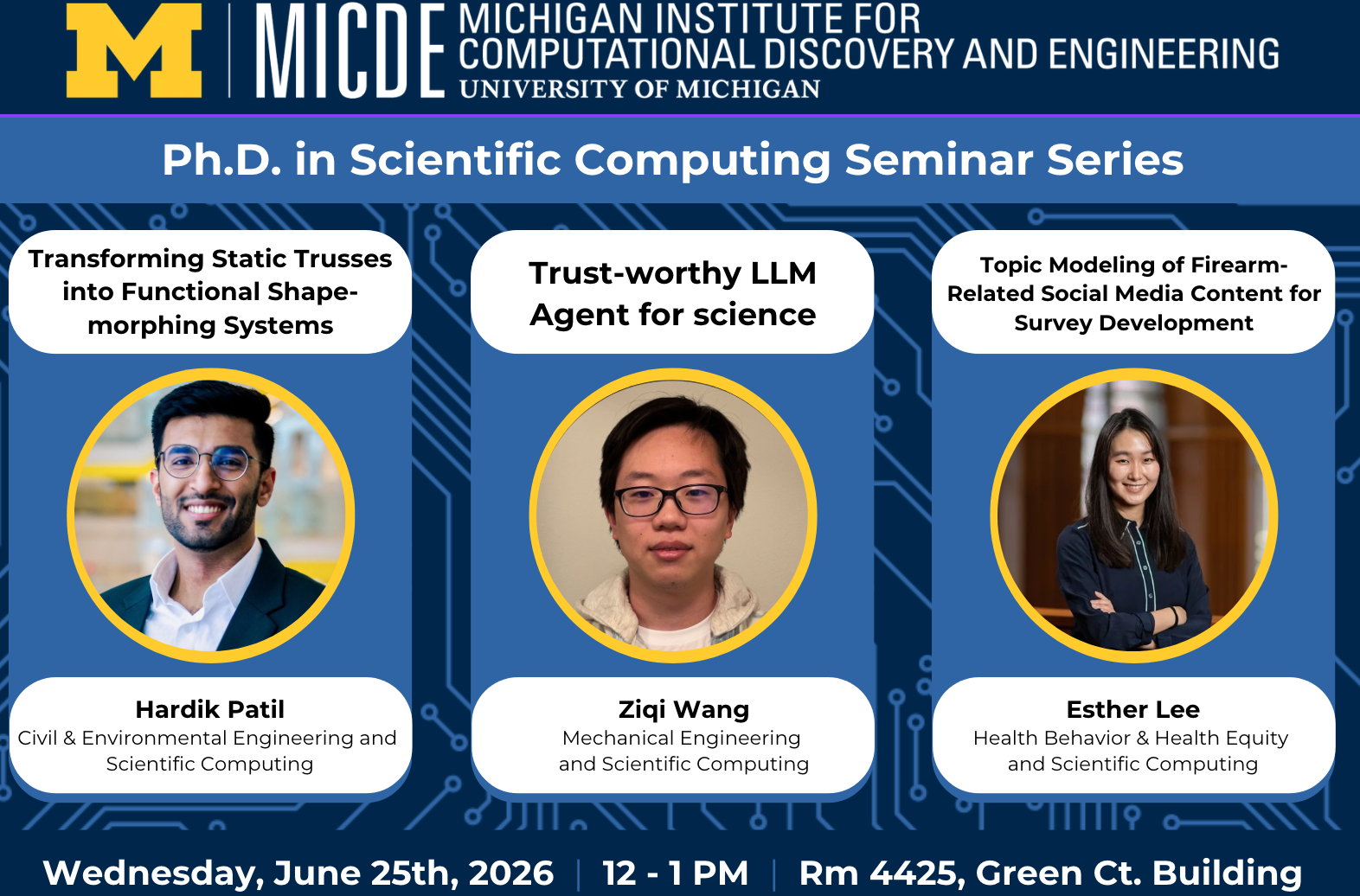
The MICDE PhD Student Seminar Series showcases the research of students in the Ph.D. in Scientific Computing. Lunch will be served. These events are open to the public, but we request that all who plan to attend register in advance. Planned sessions will be canceled if no one signs up to present, and registered attendees will be notified.
If you have any questions, please email [email protected].
Transforming Static Trusses into Functional Shape-morphing Systems
Deployable and reconfigurable infrastructure is crucial for applications such as post-disaster recovery response, temporary shelters, and aerospace systems. However, most civil structures, especially trusses, are characterized by a slow, member-by-member assembly and are locked into a single configuration post-construction. These properties make trusses ill-suited for applications requiring rapid deployment, compact storage, and controlled shape change.
To address this gap, my PhD research develops a framework that transforms static trusses into reconfigurable systems while preserving the structure’s load paths and load-bearing behavior. The framework uses quadrilateral linkage principles and member force information from a design load case to introduce additional joints in the triangular units of a truss. These joints convert triangles into flat-foldable quadrilateral linkages, in turn, adding global reconfigurability to the truss structure.
In this framework, fabrication-aware design strategies account for member thickness and joint clearances to prevent unintended overlap and interlocking during deployment of physical prototypes. Complementary kinematic simulation tools help visualize deployment trajectories and evaluate the packing efficiency during the reconfiguration of these systems.
To explore functional applications beyond civil structures, the reconfigurable trusses are augmented with torsional springs that introduce rotational resistance at the reconfiguring joints. Our work also develops computational formulations for rotational hinges and integrates them into nonlinear structural solvers to evaluate actuation force demands and system-level mechanical response. This approach enables controlled deployment and absorption of energy from impact loads through elastic buckling and multistable mechanical behavior.
Together, the tools developed in this work provide practical methods for making existing static structural designs reconfigurable and enabling programmable mechanical responses in adaptable systems beyond civil engineering.
Hardik Patil (Civil & Environmental Engineering and Scientific Computing)
Our speaker today is Hardik Patil, a fifth-year PhD student in Civil Engineering at the University of Michigan. He works with Professor Evgueni Filipov in the Regenerative, Architected, and Reconfigurable Structures Lab, where his research focuses on the design and analysis of deployable and reconfigurable bar-linked structures. Hardik earned a bachelor’s degree in Civil Engineering from the Indian Institute of Technology Bombay and a master’s degree in Structural Engineering from the University of Michigan. Today, he will presenting his work on “Transforming Static Trusses into Functional Shape-Morphing Systems”.
Trust-worthy LLM Agent for science
Density functional theory (DFT) underpins computational materials discovery, but building high-fidelity workflows demands expertise that bottlenecks exploration. Large language model (LLM) agents promise automation, yet their use in rigorous science is undermined by a trust gap: they hallucinate or misattribute numerical values, rarely support the parameter-sensitive periodic simulations central to materials work, and diagnose failures only superficially. We introduce DREAMS (DFT-based Research Engine for Agentic Materials Simulation), a hierarchical multi-agent framework for periodic solid-state DFT built around auditable results. A planning supervisor coordinates worker agents for DFT setup, HPC execution, and convergence diagnosis through the canvas, a shared memory that tracks every value’s provenance rather than passing raw text. Trust is enforced at two layers: deterministic safety guards block fabrication and value mismatch at the moment of tool use, and a report-judge agent audits each report against rules for provenance, parameter sensitivity, and rationale quality. When results still surprise, a debug tool walks the value-flow graph parameter by parameter, ruling out hidden errors before any finding is claimed as genuine. DREAMS reaches human-expert-level accuracy on Sol27LC lattice constants, resolves the contested “CO/Pt(111) puzzle” in agreement with the literature, and quantifies functional uncertainty via Bayesian statistics. These results mark a step toward L3-level automation, and the provenance, verification, and debugging mechanisms generalize to any agentic scientific workflow where numerical claims must be trusted.
Ziqi Wang (Mechanical Engineering and Scientific Computing)
Ziqi Wang is a Ph.D. candidate in Mechanical Engineering at the University of Michigan, where he is advised by Prof. Venkat Viswanathan. His research focuses on trustworthy agentic AI for computational materials science, combining large language models with high-fidelity physics-based simulations to enable autonomous scientific discovery. He leads the development of DREAMS, a hierarchical multi-agent framework for autonomous density functional theory workflows, and has applied these ideas to catalyst screening, materials discovery, and solid-state battery problems. His broader interests include first-principles thermodynamics, phase stability, interfacial materials design, and machine learning for accelerated materials screening.
Topic Modeling of Firearm-Related Social Media Content for Survey Development
Firearm violence increasingly reaches emerging adults through social media and online news, yet validated measures of online firearm violence exposure remain limited. This study applied natural language processing to firearm-related posts from Reddit and Twitter/X to inform the development of an online firearm exposure measure. After filtering irrelevant content with a fine-tuned BERT spam classifier, three topic modeling methods, Latent Dirichlet Allocation, Non-negative Matrix Factorization, and BERTopic, were applied across a large corpus of social media posts and comment threads. Topics were consolidated into nine themes that guided concrete measurement decisions, showing how topic modeling can support instrument development on sensitive topics.
Esther Lee (Health Behavior & Health Equity and Scientific Computing)
Esther Lee is a PhD candidate in Health Behavior and Health Equity at the University of Michigan School of Public Health. Her research involves examining the multilevel correlates and consequences of interpersonal gun violence, with particular attention to how firearm violence exposure affect mental health among adolescents and emerging adults.