Events

- This event has passed.
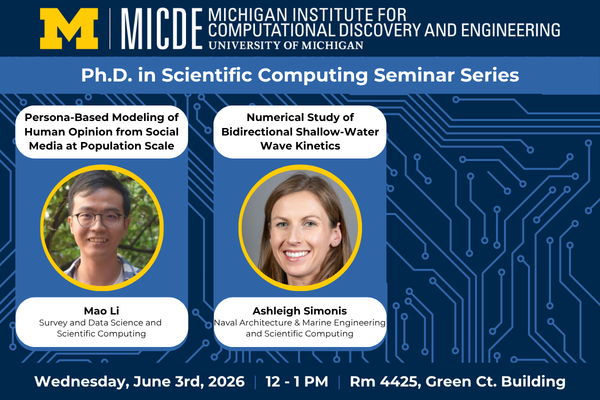
Ph.D. in Scientific Computing Student Seminar
June 3 @ 12:00 pm - 1:00 pm
Venue: Room 4425, Green Court Building
The MICDE PhD Student Seminar Series showcases the research of students in the Ph.D. in Scientific Computing. Lunch will be served. These events are open to the public, but we request that all who plan to attend register in advance. Planned sessions will be canceled if no one signs up to present, and registered attendees will be notified.
If you have any questions, please email [email protected].
Persona-Based Modeling of Human Opinion from Social Media at Population Scale
What does it take to simulate a specific human being rather than a demographic stereotype? While large language models (LLMs) generate plausible human-like text, existing simulations rely heavily on demographic correlations, which strip away individual heterogeneity and yield concentrated, homogenous responses. We introduce SPIRIT (Semi-structured Persona Inference and Reasoning for Individualized Trajectories), a framework designed explicitly for simulation rather than prediction. SPIRIT infers psychologically grounded, semi-structured personas from public social-media traces, integrating structured attributes (e.g., personality traits and world beliefs) with unstructured narrative signals reflecting values and lived experience. These personas condition LLM-based agents to act as specific individuals when answering survey questions or responding to events. Using the Ipsos KnowledgePanel, a nationally representative probability sample of U.S. adults, we show that SPIRIT-conditioned simulations recover self-reported responses more faithfully than demographic baselines and reproduce human-like heterogeneity in response patterns. We further demonstrate that persona banks can function as virtual respondent panels for studying both stable attitudes and time-sensitive public opinion.
Mao Li (Survey and Data Science and Scientific Computing)
Mao Li is a Ph.D. candidate in Survey and Data Science and Scientific Computing at the University of Michigan. His research develops and applies large language models and other computational methods to study public opinion, social media discourse, and survey-related questions.
Numerical Study of Bidirectional Shallow-Water Wave Kinetics
The traditional view is that one-dimensional shallow-water waves do not admit a wave kinetic description, as their dynamics can be described by integrable systems. We revisit this problem by studying bidirectional shallow-water waves using the integrable Kaup-Boussinesq (KB) equation and a related non-integrable variant. For both systems, a normal-form transformation yields interaction coefficients with the same general structure, differing only through the dispersion relation. We numerically confirm that the coefficient vanishes exactly on the resonant manifold for the KB equation, consistent with integrability, while the non-integrable model admits a non-zero resonant coefficient and thus a non-trivial wave kinetic equation (WKE).
The WKE is derived in the infinite-domain, weak-nonlinearity limit, where the dynamics are dominated by exact resonances. In numerical simulations, we no longer operate in this regime as computations are performed on a discrete grid at finite nonlinearity. Consequently, exact resonances may be sparse or absent, allowing for quasi-resonant interactions to play a significant role. We perform a set of numerical experiments demonstrating that these quasi-resonant interactions govern the observed spectral evolution. Despite differing on the exact resonant manifold, the integrable KB and non-integrable models exhibit nearly identical stationary spectra, revealing the dominant role of near-resonant interactions and elucidating the wave-kinetic picture in shallow-water and integrable systems.
Ashleigh Simonis (Naval Architecture & Marine Engineering and Scientific Computing)
Ashleigh is a Ph.D. candidate in the Department of Naval Architecture and Marine Engineering, advised by Dr. Yulin Pan. Her research focuses on theoretical and numerical studies of wave turbulence and coherent structures in dispersive wave systems.