Events

- This event has passed.
Ph.D. in Scientific Computing Student Seminars
July 11, 2025 @ 12:00 pm - 1:00 pm
Venue: 4th floor conference room, Green Ct.
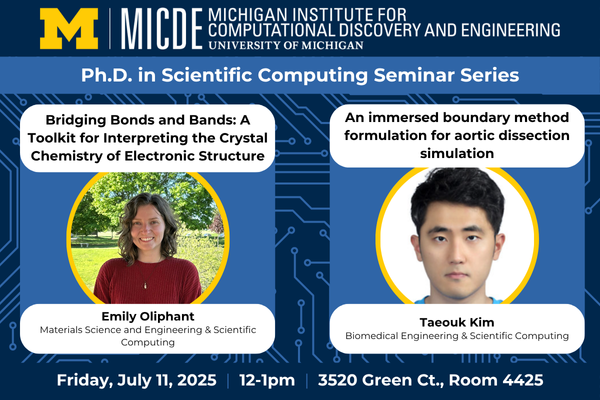
The MICDE PhD Student Seminar Series showcases the research of students in the Ph.D. in Scientific Computing. These events are open to the public, but we request that all who plan to attend register in advance.
Register to attendBridging Bonds and Bands: A Toolkit for Interpreting the Crystal Chemistry of Electronic Structure
This talk explores how we can better understand chemical bonding and electronic structure in materials using quantum mechanical calculations. I first show how specific atomic bonds shape the electronic bands of materials like silicon, using simplified models built from density functional theory (DFT). Then, I introduce a new method called COGITO, which creates a clear and flexible atomic picture of the wavefunctions in DFT. COGITO builds a set of atomic orbitals that accurately capture the full electronic structure and reveal where and how electrons are shared between atoms. This makes it possible to see and measure covalent bonds, estimate bond energies, and even understand magnetic interactions. I demonstrate how COGITO can explain why some crystal structures are more stable than others and how different DFT functionals change bonding—giving us a powerful new tool for interpreting and designing materials.
Emily Oliphant, Materials Science & Engineering and Scientific Computing
Emily Oliphant is a 5th year PhD student working with Professor Wenhao Sun and Professor Emmanouil Kioupakis. She is working to obtain atom and bonding insight in density functional theory.
An immersed boundary method formulation for aortic dissection simulation
Aortic dissection is characterized by a disruption of the intima, leading to delamination of the aortic wall and formation of a true lumen (TL) and a false lumen (FL), separated by an intimal flap or septum which moves cyclically due to pressure gradients between TL and FL. Aortic dissection can lead to complications, including end-organ malperfusion and aortic rupture. The scarcity of clinical hemodynamic data, such as pressure and flow in the TL and FL, complicates aortic dissection research, driving the use of computational simulations to study its flow dynamics and flap motion. Computational simulations can be used to study the aortic dissection dynamics and their relation to pressure gradient across TL and FL. Fluid–structure-interaction (FSI) methods have been used in aortic dissection simulations to investigate the impact of the intimal flap motion on hemodynamic parameters. While the Arbitrary Lagrangian–Eulerian (ALE) approach is widely used for the aortic dissection problems, it faces challenges: frequent fluid mesh updates increase computational costs, and mesh quality can degrade when the flap nears the aortic wall. Immersed Boundary Methods (IBM) offer an attractive alternative, avoiding fluid remeshing and effectively capturing the dynamics of thin structures, as demonstrated in heart valve simulations among other applications. In this work, we developed an IBM algorithm within a Finite Element flow solver framework using unstructured grids and computationally efficient rotation-free shell formulation to simulate aortic dissection, providing a practical approach to study its complex flow and structural behavior in patient-specific cases
Taeouk Kim, Biomedical Engineering and Scientific Computing
Taeouk is a 5th year PhD student in the Biomedical Engineering department. He is working with Dr. Alberto Figueroa at the computational vascular biomechanics lab.