Events

- This event has passed.
Ph.D. in Scientific Computing Student Seminars
February 18 @ 12:00 pm - 1:00 pm
Venue: Room 4425, Green Court Building
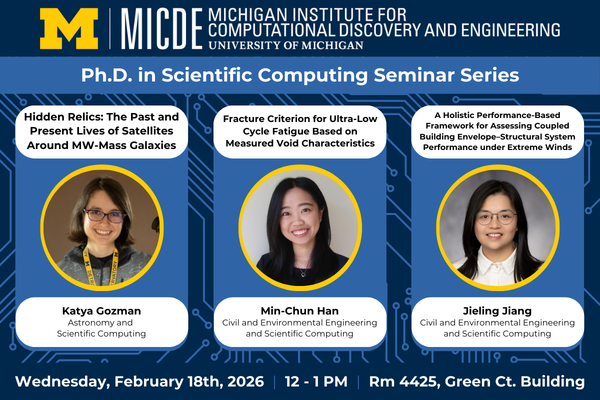
The MICDE PhD Student Seminar Series showcases the research of students in the Ph.D. in Scientific Computing. Lunch will be served. These events are open to the public, but we request that all who plan to attend register in advance. Planned sessions will be canceled if no one signs up to present, and registered attendees will be notified.
If you have any questions, please email [email protected].
Hidden Relics: The Past and Present Lives of Satellites Around MW-Mass Galaxies
Mergers are one of the most important drivers of galaxy evolution, as present-day galaxies have been built up over time through hierarchical evolution. The main bodies of galaxies have a diversity of structural properties that can be highly influenced by mergers; unfortunately, the response of a galaxy to a merger largely erases observational markers that allow us to infer the characteristics of the merger. But simulations have shown that material deposited into a galaxy through merger is retained by its stellar halo, thereby leaving a “fossil record” we can trace. My PhD thesis takes a multi-faceted approach to uncover this historical record and learn what processes govern how galaxies form and evolve, from massive Milky Way-like galaxies to their small, ultra-faint companions. I have harnessed the power of resolved-star photometry and spectroscopy to 1) create the deepest stellar halo map of the nearby galaxy M94, revealing that it underwent one of the quietest merger histories among galaxies of similar stellar mass, 2) illuminate the structural diversity of faint satellite galaxies around M81, improving ground-based characterizations and finding one of the most concentrated satellites we know of, and 3) make the first-ever measurement of the kinematics of NGC 253’s stellar halo, finding that it has slight prograde bulk motion and pioneering fiber-fed spectroscopy in a low S/N regime. With the techniques I have developed, I am laying the foundation for doing resolved stellar population science with next-generation observing facilities such as the Rubin Observatory, Roman Space Telescope, and the ELT.
Katya Gozman (Astronomy and Scientific Computing)
Katya is a 6th year PhD student in the Astronomy Department working with Prof. Eric Bell. She uses ground- and space-based observations of resolved stars in the outskirts of nearby galaxies to understand their merger histories and satellite populations.
Fracture Criterion for Ultra-Low Cycle Fatigue Based on Measured Void Characteristics
Commonly used ultra-low cycle fatigue (ULCF) fracture models rely on idealized void shapes and sizes. However, the void shapes generated by real fracture processes are irregular, forming non-uniform half-dimples and voids on the fracture surface. Therefore, a gap remains in validating the link between simulated void behavior and fracture initiation with actual fracture surface data. To address this, monotonic tensile and ULCF tests were performed on axisymmetric circumferential tensile (CNT) specimens with medium to high stress triaxiality, and dimple-voids were examined using scanning electron microscope (SEM) fractographs. For the first time, a correlation between simulated and actual void formation under ULCF was established, leading to a new fracture criterion based on measured void features.
Min-Chun Han (Civil and Environmental Engineering and Scientific Computing)
Min-Chun is a Ph.D. candidate in Civil and Environmental Engineering. Her research focuses on the behavior of structures and structural materials under extreme loading and environmental conditions.
A Holistic Performance-Based Framework for Assessing Coupled Building Envelope–Structural System Performance under Extreme Winds
High-rise building envelopes are vulnerable to extreme winds, requiring robust performance assessment to ensure safety. Existing models often assume linear or simplified post-elastic structural behavior, overlooking strong nonlinearities that can arise near collapse. This study presents a performance-based computational framework combining high-fidelity nonlinear structural modeling with a progressive damage model for envelope assessment. Localized damage mechanisms, including yielding, buckling, low-cycle fatigue, and fracture, are simulated, and envelope vulnerability is quantified via component-level sequential fragility functions. Dynamic wind pressures are captured using wind tunnel-informed stochastic models, while internal pressures at damage-induced openings are estimated via Bernoulli’s equation and mass conservation. A case study of a 45-story reinforced concrete building in New York City providing insights into the global probabilistic performance and the local coupled progression of envelope and structural damage under extreme wind events.
Jieling Jiang (Civil and Environmental Engineering and Scientific Computing)
She is currently a phd candidate in the civil engineering department, working on developing next-generation probabilistic modeling frameworks for high-rise building systems under extreme natural hazards. Her research involves high fidelity simulation and stochastic simulation methods.