Events

- This event has passed.
Ph.D. in Scientific Computing Student Seminars
February 25 @ 12:00 pm - 1:00 pm
Venue: Room 4425, Green Court Building
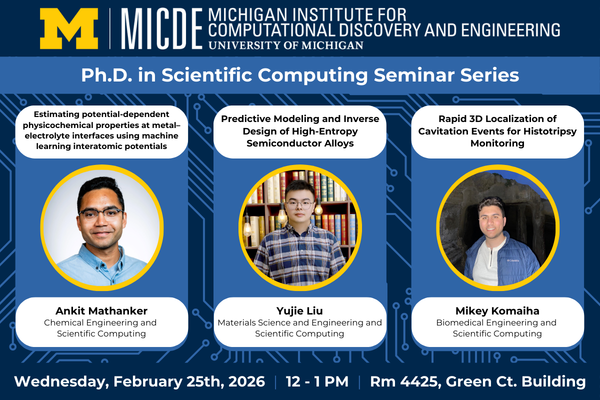
The MICDE PhD Student Seminar Series showcases the research of students in the Ph.D. in Scientific Computing. Lunch will be served. These events are open to the public, but we request that all who plan to attend register in advance. Planned sessions will be canceled if no one signs up to present, and registered attendees will be notified.
If you have any questions, please email [email protected].
Estimating potential-dependent physicochemical properties at metal–electrolyte interfaces using machine learning interatomic potentials
Metal–electrolyte interfaces play a central role in electrocatalysis, energy storage, and environmental remediation. Understanding the structure and properties of these interfaces is therefore essential to designing efficient electrochemical systems. Density functional theory (DFT)-based molecular dynamics (MD) can accurately capture interfacial structure but is restricted to short timescales and small system sizes. To overcome these limitations, we develop machine learning interatomic potentials (MLIPs) using the MACE architecture within an active learning workflow to model aqueous NaCl electrolytes in contact with Au, Cu, and Rh (111) electrodes. The resulting committee of MLIPs achieves DFT-level accuracy across 21 electrolyte–metal systems spanning a wide range of surface charge densities. MACE–MD simulations reproduce key interfacial properties obtained from ab initio MD, including water density profiles, water orientation, and chemisorbed water coverage.
Our simulations reveal a universal trend across all metals: the total coverage of water and ions decreases with increasing surface charge density or potential, reaches a minimum at or slightly below the pzc, and increases thereafter. Overall, this work demonstrates that MLIPs based on the MACE architecture enable long-timescale, first-principles-accurate simulations of metal electrolyte interfaces and provide detailed mechanistic insight into their potential-dependent physicochemical properties.
Ankit Mathanker (Chemical Engineering and Scientific Computing)
Ankit Mathanker is a Ph.D. researcher in Chemical Engineering in the Goldsmith Lab. His work leverages DFT, AIMD, and machine-learning interatomic potentials to understand and predict electrochemical interfacial phenomena relevant to catalysis and energy conversion.
Predictive Modeling and Inverse Design of High-Entropy Semiconductor Alloys
The vast compositional space of high-entropy semiconductors offers unprecedented tunability but presents a significant challenge for traditional screening methods. This talk outlines a multi-tiered computational strategy designed to navigate this complexity, applied specifically to ferroelectric high-entropy III-nitrides (AlGaInScY-N). We detail a comprehensive workflow that begins with high-throughput first-principles calculations to generate accurate stability and property datasets. We then demonstrate how this data fuels a dual-pronged AI approach, which uses generative machine learning (symbolic regression) to discover interpretable governing equations for phase stability, and black-box machine learning models to rapidly predict structural properties and band gaps beyond the training set. This synergistic framework not only accelerates materials discovery but also reveals the physical descriptors driving entropy stabilization and ferroelectric performance.
Yujie Liu (Materials Science and Engineering and Scientific Computing)
Yujie is a Ph.D. student from materials science and engineering. He is working on semiconductor materials design, combineing high-throughput first-principles workflows with surrogate machine-learning models.
Rapid 3D Localization of Cavitation Events for Histotripsy Monitoring
Histotripsy is a noninvasive ultrasound therapy that relies on controlled cavitation to mechanically fractionate tissue, but accurately localizing cavitation events in real time remains a challenge, particularly in the presence of acoustic aberrations and attenutation. This talk presents computational and experimental methods for rapid three-dimensional localization of inertial cavitation events using a large-aperture, receive-capable focused ultrasound array. By combining narrowband signal processing with passive acoustic mapping techniques, these methods enable high-accuracy cavitation localization at clinically relevant treatment rates. Experimental validation using optical imaging and rib-mimicking phantoms demonstrates the potential of these approaches for treatment monitoring and feedback control in therapeutic ultrasound.
Mikey Komaiha (Biomedical Engineering and Scientific Computing)
Mikey is a Ph.D. candidate in the Department of Biomedical Engineering at the University of Michigan and a member of the Histosonics research group. His research focuses on computational signal processing and experimental methods for cavitation localization and monitoring in therapeutic ultrasound applications.