Events

- This event has passed.
MICDE – Chemistry Joint Seminar: Shaama Sharada, University of Southern California
October 15 @ 4:00 pm - 5:00 pm
Venue: CHEM 1640
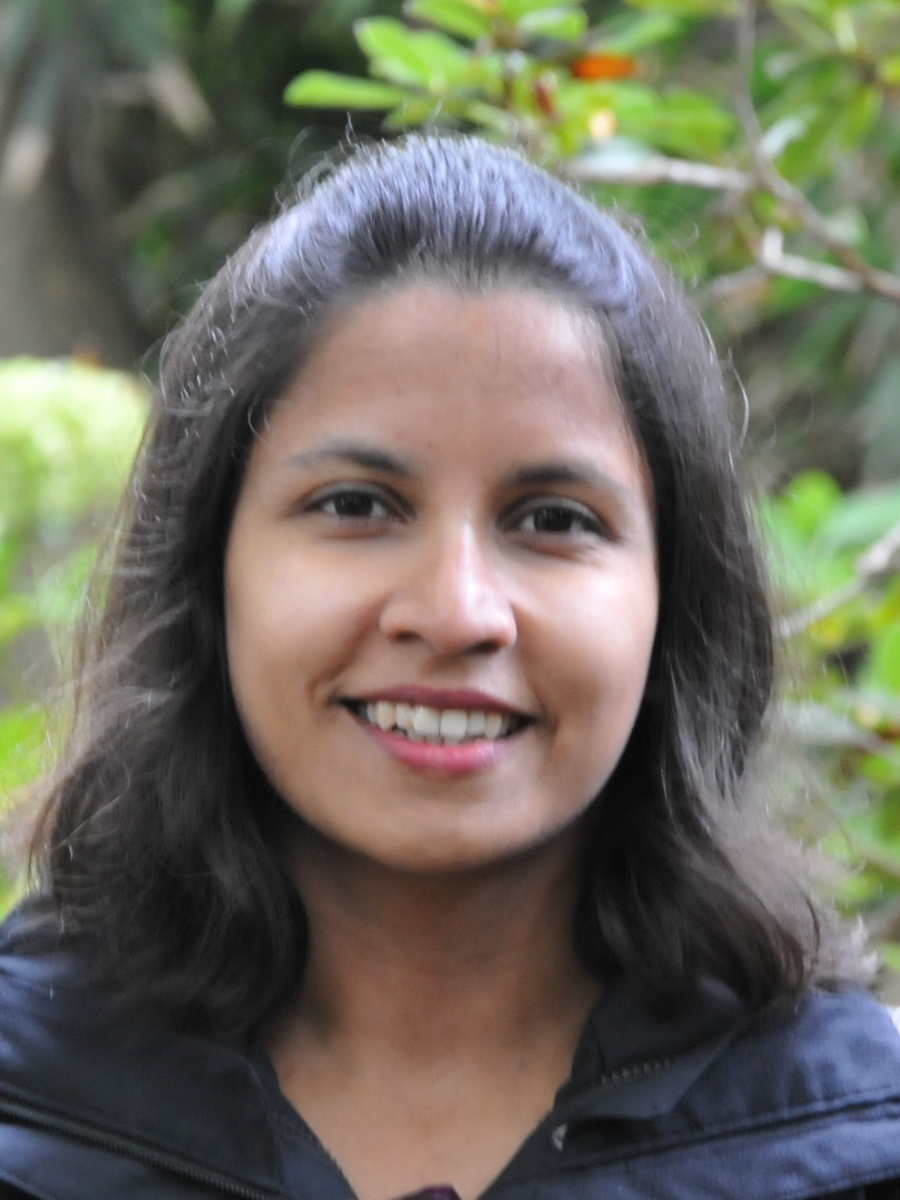
Bio: Shaama Sharada is the Chester Dolley Early Career Chair and Associate Professor of Chemical Engineering and Materials Science and Chemistry at USC Viterbi School of Engineering. She earned her undergraduate degree in Chemical Engineering from the Indian Institute of Technology, Bombay, and her PhD from the University of California, Berkeley, where she also served as a software developer for Q-Chem, a quantum chemistry package. She was a postdoctoral researcher at Stanford University prior to joining USC in Fall 2017.
Her research focuses on developing catalysts and photocatalysts to meet energy-efficiency and sustainability goals. Her group utilizes quantum chemistry to find active, selective, and stable catalytic materials for efficient valorization of CH bonds and green conversion of anthropogenic carbon dioxide. Shaama is also keen on making quantum chemical predictions more reliable. She is developing algorithms inspired by signal processing to make otherwise prohibitive but accurate kinetics theories more tractable for routine studies.
Catalyst discovery for metal-free, photoredox CO2 reduction
Our goal is to identify sustainable, light-driven routes for CO2 utilization. Prior experiments show that upon excitation by light and subsequent reduction, a simple organic chromophore, p-terphenyl, can reduce and transform CO2 into valuable molecules such as amino acids. These photoredox reactions are attractive because organic chromophores are metal-free and can access highly reactive states upon excitation and quenching that are otherwise energy-intensive. However, the steps of the photoredox cycle and the reasons for the low turnover numbers of these catalysts are poorly understood. We use state-of-the-art quantum chemistry methods and automated workflows to delineate mechanisms of steps constituting the catalytic cycle, develop design principles, and leverage these insights to drive the discovery of viable chromophores. The driving force for the desired electron transfer (ET) step to reduce CO2 cannot be increased without simultaneously increasing that for competing deactivation via carboxylation; this indicates the existence of fundamental relationships that limit catalyst performance. Deactivation can also occur via Birch reduction of the catalyst by the radical cation form of the sacrificial electron donor. These steps are highly sensitive to the choice of solvent, as is the quenching of the excited-state catalyst. I will describe our work establishing a protocol for calculating and characterizing excited-state complexes (exciplexes) that are the result of incomplete quenching. I will also share our recent efforts towards applying structural causal frameworks to photoredox chemistry.
The MICDE 2026-27 Seminar Series is open to all.
Graduate Certificate in Computational Discovery and Engineering, and MICDE fellows, please use this form to record your attendance.
Questions? Email [email protected]