Events

- This event has passed.
Ph.D. in Scientific Computing Seminar Series
October 28, 2025 @ 11:45 am - 12:45 pm
Venue: North Quad – 2185
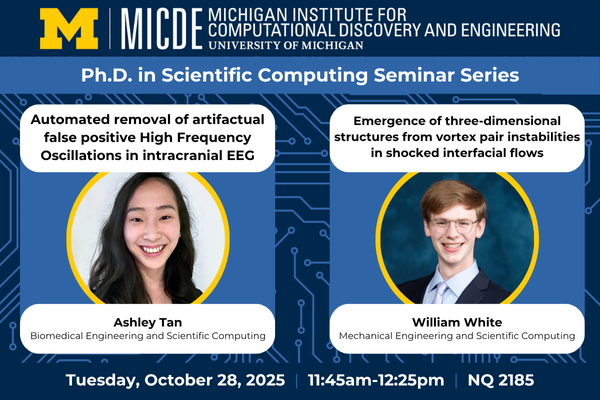
The MICDE PhD Student Seminar Series showcases the research of students in the Ph.D. in Scientific Computing. Lunch will be served. These events are open to the public, but we request that all who plan to attend register in advance. Planned sessions will be canceled if no one signs up to present, and registered attendees will be notified.
If you have any questions, please email [email protected].
Automated removal of artifactual false positive High Frequency Oscillations in intracranial EEG
High frequency oscillations (HFOs) are a promising biomarker of the epileptogenic zone. Automated HFO detectors alleviate manual labeling but false positives, artifacts, remain. Clinicians recognize artifacts readily while viewing the EEG at standard resolution across channels, and observing artifacts at the times of HFO events leads to a loss of trust in the detections. In this work, we collect a new gold standard of HFO labeling using clinician expertise, train several machine learning algorithms, and develop an artifact filter compatible with any HFO detector to distinguish between true and false positives.
Ashley Tan (Mechanical Engineering and Scientific Computing)
Her research involves developing engineering tools to control epilepsy. She is currently developing machine learning methods for artifact detection of a potential biomarker and investigating the effects of electrical brain stimulation on pathological activity.
Emergence of three-dimensional structures from vortex pair instabilities in shocked interfacial flows
The Crow instability is a vortex-line instability that leads to the three-dimensional growth of perturbations in counter-rotating vortices, with pinch-off leading to the generation of vortex rings at late time. Classically, two incompressible, inviscid vortices are studied in this context; in the present work, we use numerical simulations to demonstrate that the cores which are generated from the compressible multi-material Richtmyer-Meshkov instability are subject to the Crow instability. Thus, the onset of the Crow instability from the Richtmyer-Meshkov-induced cores can act as a mechanism for transitioning a nominally two-dimensional Richtmyer-Meshkov flow to three dimensions.
William White (Mechanical Engineering and Scientific Computing)
William is a PhD student in the Scientific Computing and Flow Physics Lab working on high-order numerical methods for compressible interfacial flows, as well as interfacial and vortex-line hydrodynamic instabilities.