Events

- This event has passed.
Ph.D. in Scientific Computing Seminar Series
November 4, 2025 @ 11:45 am - 12:45 pm
Venue: North Quad – 2185
The MICDE PhD Student Seminar Series showcases the research of students in the Ph.D. in Scientific Computing. Lunch will be served. These events are open to the public, but we request that all who plan to attend register in advance. Planned sessions will be canceled if no one signs up to present, and registered attendees will be notified.
If you have any questions, please email [email protected].
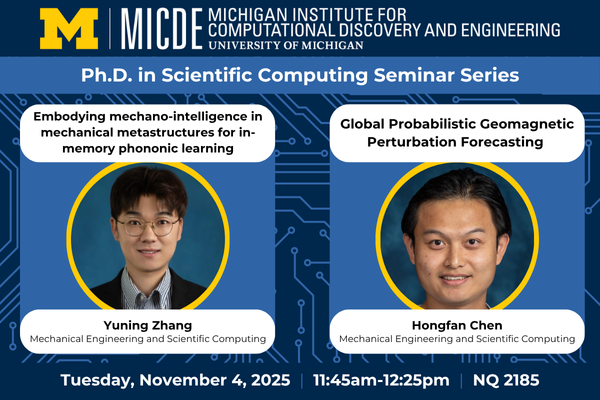
Embodying mechano-intelligence in mechanical metastructures for in-memory phononic learning
Mechano-intelligence (MI)—intelligence embodied within the mechanical domain of materials and structures—promises autonomous systems with higher effectiveness, efficiency, and resilience. Rather than outsourcing information processing entirely to electronics, MI envisions materials that store, process, and adapt to environmental inputs through intrinsic mechanical responses, reducing latency and energy while improving robustness in extreme and cyber-contested conditions. Realizing MI requires three elements: a memory module to retain knowledge from inputs, a computing module to interpret and act on information, and a physical communication interface linking storage and computation. In this talk, I will introduce a new approach to realizing MI in and through a reconfigurable phononic metastructures via the concept of in-memory phononic learning, where mechanical states are programmed to encode and store information and the elastic-wave physics is harnessed to carry out computation and decision—a framework that unifies the full information chain in the mechanical domain and provides efficient, physically interpretable processing by using elastic waves as the natural communication and processing medium.
Yuning Zhang (Mechanical Engineering and Scientific Computing)
Yuning is a Ph.D. candidate in Mechanical Engineering under Prof. Kon-Well Wang. His research focuses on wave propagation in phononic metastructures, and the development of physical computing and mechanical intelligence.
Global Probabilistic Geomagnetic Perturbation Forecasting
Accurately predicting the horizontal component of the ground magnetic field perturbation (dBH), as a proxy for Geomagnetically Induced Currents (GICs), is crucial for estimating the impact of geomagnetic storms and remains a topic under active investigation. The current operational Geospace model is computationally expensive for fine-grid global simulations, while existing machine learning methods consistently tend to underestimate dBH. Additionally, these models either lack uncertainty quantification (UQ), which is either overlooked or treated as secondary. In this work, as part of the NextGen SWMF project funded by NSF, we develop a data-driven, grid-free global model using deep Gaussian process (DGP), a Bayesian non-parametric approach that forecasts the dBH for the full surface of Earth with calibrated uncertainty. The model uses solar wind measurements and the Dst index as input, and it is trained based on ground magnetometer station data provided by SuperMAG over the period 1995-2022. The model’s predictions are evaluated based on the Heidke skill score (HSS) for a total of 23 storms in 2015. We further test the model on the 2024 Gannon superstorm. The results demonstrate that our model outperforms the state-of-the-art model, with predictions exhibiting high accuracy in mid-latitudes and high-latitude regions in the northern hemisphere.
Hongfan Chen (Mechanical Engineering and Scientific Computing)
Hongfan Chen is a fourth-year PhD student in Mechanical Engineering and the Michigan Institute for Computational Discovery and Engineering (MICDE) Scientific Computing program. His research develops computational methods for uncertainty quantification (UQ) and machine learning (ML) in complex scientific and engineering systems, with emphases on data assimilation (DA), knowledge-guided machine learning, and optimal experimental design (OED).