Events

- This event has passed.
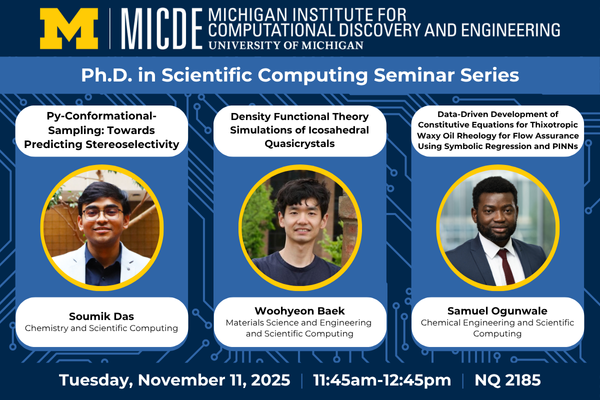
Ph.D. in Scientific Computing Seminar Series
November 11, 2025 @ 11:45 am - 12:45 pm
Venue: North Quad – 2185
The MICDE PhD Student Seminar Series showcases the research of students in the Ph.D. in Scientific Computing. Lunch will be served. These events are open to the public, but we request that all who plan to attend register in advance. Planned sessions will be canceled if no one signs up to present, and registered attendees will be notified.
If you have any questions, please email [email protected].
Py-Conformational-Sampling: Towards Predicting Stereoselectivity
Stereoselective reactions are an integral part of organic synthesis due to the abundance of chiral centers in natural products and drug molecules. The design of these reactions remains challenging due to specific substrate requirements, delicate reaction conditions and more importantly, multiple competing product-forming transition states (TSs). These TSs often arise from a range of conformers present within the reactant complex. Thus, predicting stereoselectivity requires detailed insights into favorable interactions amidst the conformational ensemble. This work introduces Py-Conformational-Sampling (PyCoSa) as a methodical approach to sample transition-metal-catalyzed stereoselective reactions. This technique, when devoted to atroposelective Suzuki-Miyaura coupling to generate axially chiral biaryl products, shows a variety of mechanistic possibilities through which C(sp2)–C(sp2) bond formation takes place.
Soumik Das (Chemistry and Scientific Computing)
Soumik is currently pursuing Ph.D. in Chemistry and Scientific Computing under the supervision of Dr. Paul Zimmerman. His research interests involve developing and applying automated and predictive computational tools using quantum chemistry for reaction design and discovery. Among other things, he’s also a recipient of MICDE Graduate Fellowship for the academic year 2023-2024 and presented his research in MICDE conference SciFM ’24.
Density Functional Theory Simulations of Icosahedral Quasicrystals
Quasicrystals (QCs) are fascinating materials with their long-range aperiodicity and forbidden rotational symmetry, which opened a new type of classification in crystallography and attracted much attention to its potential applications to condensed matter, statistical and solid-state physics. The characterization and identification of QCs after the first discovery is widely undertaken, but thermodynamic stability and kinetics of nucleation are ongoing questions to answer the synthesizability and design novel structures. The quantum mechanical simulation including the density functional theory (DFT) is a widely used method for atomic-scale simulation, however, aperiodicity of QC structure makes it challenging to apply a computational model for periodic boundary frameworks. In this present work, atomistic simulation of Tsai-type ScZn and YbCd icosahedral quasicrystals (iQCs), which is one of recently discovered iQCs types, were performed using density functional theory – finite element (DFT-FE) method to study the thermodynamic stability, role of surface energy to the stability, and driving force of QC formation. The size-dependent and mixed-thermodynamic-and-kinetic phase diagram from quantitative theoretical calculations can provide fundamental insights into the origin of QC formation.
Woohyeon Baek (Materials Science and Engineering and Scientific Computing)
Woohyeon Baek is a PhD student in Materials Science and Engineering and Scientific Computing under the supervision of Dr. Wenhao Sun. He is working on the thermodynamics and kinetics of non-traditional materials formation from computational simulations including quasicrystals, minerals, functional materials, and organic crystals.
Data-Driven Development of Constitutive Equations for Thixotropic Waxy Oil Rheology for Flow Assurance Using Symbolic Regression and PINNs
Waxy crude oils crystallize below the wax appearance temperature, forming networks that make rheology strongly dependent on temperature and prior shear history, complicating pipeline restart operations. We develop a compact, predictive modeling framework that combines data-driven and mechanistic approaches, with all methods using differential scanning calorimetry crystallinity measurements to encode temperature effects. Symbolic regression (PySR) trained on two temperatures accurately predicts steady-state flow curves at remaining temperatures. A Fractal Isotropic-Kinematic Hardening (FIKH) model, fitted at two temperatures for steady response, predicts steady behavior at other temperatures; for transients, parameters identified at 5°C reproduce rejuvenation and recovery dynamics at additional temperatures. We introduce LFP-IKH (Liquid Free-Path IKH), a novel approach that defines the structural state as liquid-network connectivity bounded by crystallinity. When calibrated only on steady-state data, LFP-IKH predicts both steady and transient responses across all temperatures without refitting. This yields a mechanism-based framework that requires no parameter adjustment across temperature ranges, making it suitable for flow-assurance prediction and restart design applications.
Samuel Ogunwale (Chemical Engineering and Scientific Computing)
Samuel Ogunwale is a sixth-year PhD student in Chemical Engineering working in the Larson group. His research focuses on developing predictive models for complex fluid systems, combining mechanistic understanding with experimental validation to address industrial flow assurance challenges.