Events

- This event has passed.
Ph.D. in Scientific Computing Seminar Series
November 18, 2025 @ 11:45 am - 12:45 pm
Venue: North Quad – 2185
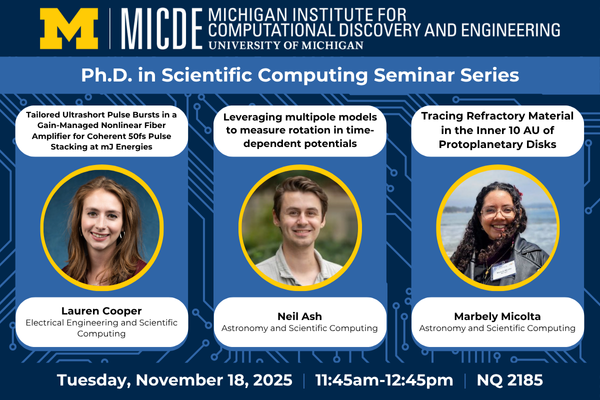
The MICDE PhD Student Seminar Series showcases the research of students in the Ph.D. in Scientific Computing. Lunch will be served. These events are open to the public, but we request that all who plan to attend register in advance. Planned sessions will be canceled if no one signs up to present, and registered attendees will be notified.
If you have any questions, please email [email protected].
Tailored Ultrashort Pulse Bursts in a Gain-Managed Nonlinear Fiber Amplifier for Coherent 50fs Pulse Stacking at mJ Energies
We show a method of scaling gain-managed nonlinear amplifiers (GMNA) to mJ energies using feedback-driven scaling of pulse bursts that can be time-combined into a single 50fs output pulse using coherent pulse stacking.
Lauren Cooper (Electrical Engineering and Scientific Computing)
Lauren Cooper is working on coherent pulse stacking of gain-managed nonlinear amplified pulse bursts for high power applications. She is being advised by Professor Almantas Galvanauskas in the Electrical Engineering department at the University of Michigan.
Leveraging multipole models to measure rotation in time-dependent potentials
Multipole expansion models are efficient and flexible methods by which to encode aspherical and time-dependent fluctuations in 3D functions of galactic densities and potentials. Historically these techniques have been used primary to perform orbit integration and N-body simulations. However, it is becoming increasingly clear that the expansion series coefficients encode useful physical information that may be used to discover novel dynamics. In this talk, I will outline my recent work using multipole expansion coefficient series, including methods I have developed for measuring rotation in the quadrupole component and the discoveries multipole expansion has facilitated.
Neil Ash (Astronomy and Scientific Computing)
Neil is a 5th year graduate student in the Astronomy Department working with Professor Monica Valluri. His research interests include hydrodynamical simulations of cosmic structure formation and galactic dynamics, with a special focus on the dark matter haloes and their interactions with the baryonic (stellar) galactic component.
Tracing Refractory Material in the Inner 10 AU of Protoplanetary Disks
Planets form in protoplanetary disks by building their cores from rocky/refractory material that drifts inward toward the central star, establishing this material as the fundamental building blocks of all planets. Identifying the physical processes that regulate rocky material within the inner 10 AU during disk evolution is essential for understanding the formation of the observed diversity of planetary systems, particularly for all rocky planets. In my PhD dissertation, I study the content of rocky material in the inner regions of protoplanetary disks. I utilize spectroscopic observations across the entire electromagnetic spectrum, using both ground-based and space telescopes, to disclose how much rocky material reaches the inner disk and what its composition is. I have found (1) evidence for refractory depletion in the inner gas disk, 2) connections between age and dust-trapping/planet-forming mechanisms with higher depletion values, and 3) estimates of the impact of sublimation temperature and dust drifts on the composition of rocky material in the inner disk. Overall, my work probes dust trapping and dust drift theories.
Marbely Micolta (Astronomy and Scientific Computing)
I’m a fifth-year Ph.D. student in Astronomy, working with Prof. Nuria Calvet. I’m from Venezuela. My research aims to constrain the physical and chemical processes that regulate rocky (refractory) material, the building blocks of planets, in the inner 10AU of protoplanetary disks. I have developed a broad expertise in disk characterization, using observations across the electromagnetic spectrum, both from the ground and space telescopes.