Events

- This event has passed.
Ph.D. in Scientific Computing Seminar Series
December 9, 2025 @ 11:45 am - 12:45 pm
Venue: North Quad – 2185
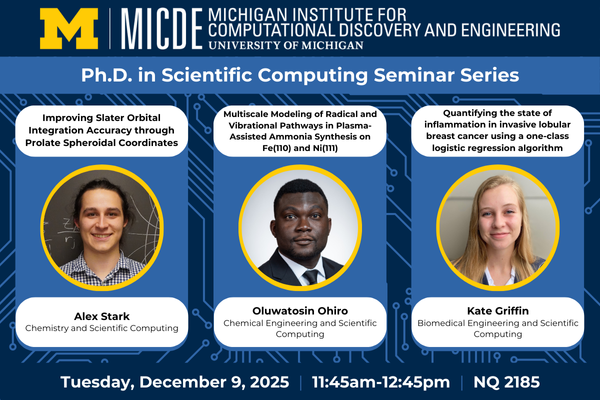
The MICDE PhD Student Seminar Series showcases the research of students in the Ph.D. in Scientific Computing. Lunch will be served. These events are open to the public, but we request that all who plan to attend register in advance. Planned sessions will be canceled if no one signs up to present, and registered attendees will be notified.
If you have any questions, please email [email protected].
Improving Slater Orbital Integration Accuracy through Prolate Spheroidal Coordinates
The core of electronic structure calculations is the integration of forces exerted on and by
electrons and nuclei in a system. Some of these interactions have forms which manifest in such a way that makes integration challenging depending on the choice of basis (specifically Slater Type Orbitals (STOs)). This difficulty lies in the fact that not all integrals have a known analytically integrable form when Slater functions are used as a basis. The Prolate Spheroidal coordinate system has only been applied to diatomic systems, but offers an advantage in numerical integration accuracy over more generally applicable schemes. A third center is added in the PS coordinate grid in this work, where we will note the challenges and steps taken to handle a third center. It is important to note that the addition of a third center is sufficient to solve all integrals required by the Hamiltonian under the Resolution of the Identity(RI) approximation. Analysis was performed using metrics which test the scheme directly (error values for integral matrix elements) and indirectly(applying integrals to Hartree-Fock(HF) and post-HF methods to get observables). The methods ability to accurately calculate 2-center properties allows for the use of larger basis sets which were previously unserviceable.
Alexander Stark (Chemistry and Scientific Computing)
This is Alexander Stark, he is in the Zimmerman group in the chemistry department, his research involves refining different levels of wave-function theory as to improve the accuracy of predictions.
Multiscale Modeling of Radical and Vibrational Pathways in Plasma-Assisted Ammonia Synthesis on Fe(110) and Ni(111)
Low-temperature plasma (LTP)-assisted ammonia synthesis is a promising alternative to the Haber-Bosch process for decentralized, renewable energy-driven production. Progress has been limited by an incomplete mechanistic understanding, particularly the debated roles of vibrationally excited N2(g),ν and plasma-generated N · /H · radicals, which may explain the unexpected insensitivity of catalyst performance across metals. We apply first-principles multiscale modeling—combining density functional theory (DFT) calculations and a packed-bed reactor microkinetic model—to disentangle these contributions to LTP-assisted NH3(g) synthesis over Fe(110) and Ni(111) catalysts. The model incorporates an experimentally derived vibrationally excited N2(g),ν distribution from a radiofrequency (RF) plasma source and accounts for their vibrational surface quenching. The model predicts that vibrational excitation enhances the dissociation of N2(g),ν on Ni but its impact on Fe is limited. Quenching of vibrationally excited N2(g),ν
due to collisions with the reactor walls and the catalyst surface does not significantly affect ammonia yields on either catalyst, with less an an order of magnitude increase. In contrast, Eley-Rideal reactions involving N · and H · radicals dominate ammonia formation, bypassing the conventional rate-controlling steps of thermal catalysis on Fe and Ni materials. This mechanistic picture explains the experimentally observed insensitivity of ammonia production rates to metal catalyst identity and highlights the central role of radical chemistry in plasma-assisted ammonia synthesis.
Oluwatosin Ohiro (Chemical Engineering and Scientific Computing)
Oluwatosin earned his primary degree in petroleum and gas engineering and worked for several years as a reservoir engineer and oil asset planner. He is currently pursuing his PhD in the Chemical Engineering Department under the supervision of Prof. Bryan Goldsmith. His research focuses on the interface of computational materials science and heterogeneous catalysis.
Quantifying the state of inflammation in invasive lobular breast cancer using a one-class logistic regression algorithm
After invasive ductal cancer (IDC), invasive lobular cancer (ILC) is the second most diagnosed type of breast cancer. Given complexities with detection, patients with ILC may be diagnosed at an advanced stage of disease, presenting larger tumors and a higher metastasis incidence when compared to IDC. It is increasingly appreciated that the immune system plays a crucial role in both primary tumor and metastatic progression and is a complex balance of both innate and adaptive immune interactions. Critically, the success of modern immunotherapies, such as immune checkpoint blockade, depends not only on the T cells on which they directly act, but also the complicated and often contradictory influence of innate myeloid cells on the lymphoid compartment. Innate myeloid cells in the tumor microenvironment (TME) have the potential to be both pro- and anti-cancer and often present in a spectrum within the TME. The dynamic nature of these immune components makes understanding and interpreting the state of the immune system in the TME very difficult. Simple methods, like quantifying tumor infiltrating lymphocytes (TILs) or tumor-associated macrophages (TAMs) do not account for the function of these cells, which may be pro- or anti-tumor. We investigated the role of the immune system in the tumor microenvironment (TME) of ILC by developing a machine learning-based inflammation score (IS) that can quantify the complex state of the immune system within a primary tumor on a numerical scale from pro- to anti-inflammatory. We correlate the IS with overall survival and disease-free survival to set prognostic thresholds for immune dysregulation.
Kate Griffin (Biomedical Engineering and Scientific Computing)
Kate is a PhD Candidate in Biomedical Engineering in the Shea Lab. Her research involves engineering nanoparticles to reverse immunosuppression in metastatic breast cancer, and using computational methods to understand immune dysregulation in the metastatic niche.