
FSML Lecture Series – Panos Stinis: When big neural networks are not enough: physics, multi-fidelity and kernels
2004 Lay Auto LabWhen big neural networks are not enough: physics, multi-fidelity and kernels

When big neural networks are not enough: physics, multi-fidelity and kernels
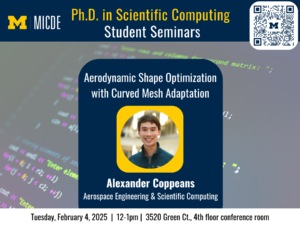
Alexander Coppeans (Aerospace Engineering): Aerodynamic Shape Optimization with Curved Mesh Adaptation
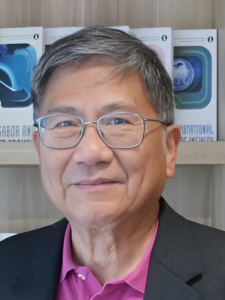
Heaviside Composite Optimization, a new paradigm of optimization
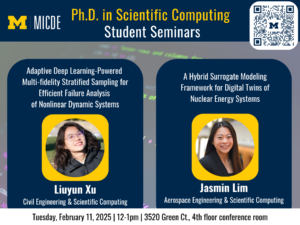
Liuyun Xu (Civil Engineering): Adaptive Deep Learning-Powered Multi-fidelity Stratified Sampling for Efficient Failure Analysis of Nonlinear Dynamic Systems
Jasmin Lim (Aerospace Engineering): A Hybrid Surrogate Modeling Framework for Digital Twins of Nuclear Energy Systems

Identifying coherent structures and controlling turbulent flows through deep learning
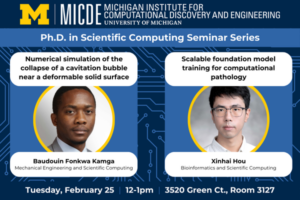
Baudouin Fonkwa Kamga (Mechanical Engineering): Numerical simulation of the collapse of a cavitation bubble near a deformable solid surface
Xinhai Hou (Bioinformatics): Scalable foundation model training for computational pathology

From Turbulent Flows to Video Games: Managing Large-Scale Data with Tensor Decomposition
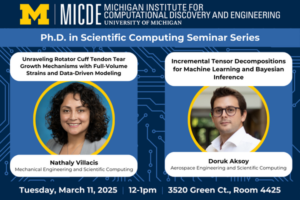
Nathaly Villacis (Mechanical Engineering): Unraveling Rotator Cuff Tendon Tear Growth Mechanisms with Full-Volume Strains and Data-Driven Modeling
Doruk Aksoy (Aerospace Engineering): Incremental Tensor Decompositions for Machine Learning and Bayesian Inference

Flow matching in cell trajectories and protein design
Abstract: Generative flow models learn a (possibly stochastic) mapping between source and target distributions. Common paradigms include diffusion models, score matching models, and continuous normalizing flows. In this talk I will first present methods for improved training of flow models using flow matching objectives using ideas from optimal transport. I will then show how these […]