XSEDE HPC Summer Bootcamp
NCRC B16 B003E 2800 Plymouth Rd., Ann Arbor, MI, United States11 a.m. to 5 p.m., June 4-7, 2018
This 4 day event will include MPI, OpenMP, OpenACC and accelerators.

11 a.m. to 5 p.m., June 4-7, 2018
This 4 day event will include MPI, OpenMP, OpenACC and accelerators.
This is the first workshop in a series of three workshops that will cover spatial modeling of three broad classes of data: (i) spatial point pattern, (ii) discrete spatial variation on areal units, and (iii) continuous spatial variation. Spatial point (and marked point) process models help us analyze the geometrical pattern of points in space […]
Please join us for the second annual Single-cell Genomic Data Analytics Symposium. The day long symposium will highlight researchers from U-M and around the world whose work is on the leading edge of innovation and discovery. This symposium is organized by the Michigan Center for Single-Cell Genomic Data Analytics and sponsored by the Michigan Institute […]
ARC-TS and the Scientific Computing Student Club are hosting a satellite site for XSEDE hands-on workshops during this summer. These workshops provide a convenient way for researchers to learn about the latest techniques and technologies of current interest in HPC. This one-day event will focus on OpenMP. Please fill out this google form if you are interested in attending either workshop and would like more information. […]
Geostatistics deals with continuous variation over space and emphasizes the idea of spatial correlation via covariance. It is widely used for spatial interpolation. We will use ArcGIS and R to explore and develop an understanding of variogram and kriging and how they can be used for robust and unbiased interpolation of data over space. The […]
Low-rank tensor approaches for adaptive function approximation: algorithms and examples In this talk, we present an adaptive method for approximating high-dimensional low-rank functions. Taking advantage of low-rank structure in approximation problems has been shown to prove advantageous for scaling numerical algorithms and computation to higher dimensions by mitigating the curse-of-dimensionality. The method we describe is […]
Data-intensive social science is one of the research focus areas that MIDAS supports with its Challenge Awards. Our long-term goal is to support this research area more broadly, using the Challenge Award projects as the starting point to build a critical mass. This symposium offers a platform for all participants to explore collaboration opportunities and […]
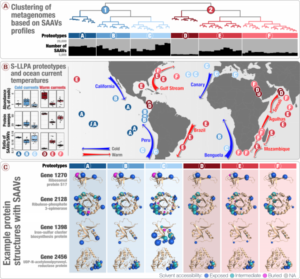
Insights into ecology and evolution of microbial populations through single-amino acid variants
Two topics in computational fluid dynamics 1. The Lamb dipole is a steady propagating solution of the inviscid fluid equations with opposite-signed vorticity in a circular disk. We compare finite-difference solutions of the Navier-Stokes equation (NSE) and the linear diffusion equation (LDE) using the Lamb dipole as the initial condition. We find some expected and […]
Learn about graduate programs that will prepare you for success in computationally intensive fields — pizza and pop provided The Ph.D. in Scientific Computing is open to all Ph.D. students who will make extensive use of large-scale computation, computational methods, or algorithms for advanced computer architectures in their studies. It is a joint degree program, with students earning […]