
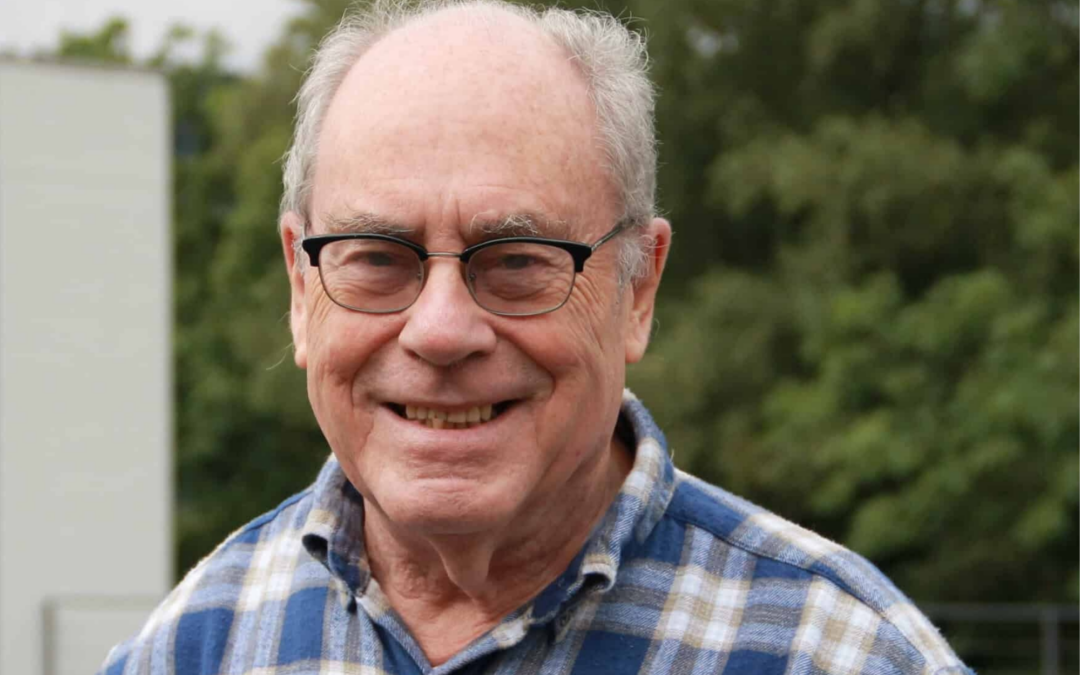
Phil was born in Derby, England, and attended Cambridge University, where he received his BA (Dipl Aero) and PMA in 1962. From 1962 to 1984, he was a Government Scientist at the Royal Aircraft Establishment (RAE) in the United Kingdom. In 1990, he joined the faculty at the University of Michigan, with a joint appointment in the Department of Aerospace Engineering and the Laboratory for Advanced Scientific Computing, the predecessor to the Michigan Institute for Computational Discovery & Engineering (MICDE).
After Phil’s arrival at the University of Michigan, he, Bram van Leer, and Ken Powell founded the W.M. Keck Foundation Computational Fluid Dynamics (CFD) Laboratory. The lab became a leading center for CFD, bolstering Michigan’s reputation as being at the forefront in computational science. Phil taught at Michigan until 2021, when he retired and was awarded Emeritus status. He also served as the William Penney Visiting Professor at Cambridge University from 2008 to 2016. He was Editor-in-Chief of the Journal of Computational Physics from 1992 to 1994.
Phil made seminal contributions in applied aerodynamics and computational fluid dynamics. He was one of the originators of the “waverider” concept for hypersonic flight, in which a vehicle is specifically designed geometrically so as to ride on top of shock waves created by the vehicle’s leading edges. He was also a pioneer of upwind-differencing methods for computational fluid dynamics, leading to a class of methods still dominant in use for problems in a wide variety of disciplines. His 1981 paper “Approximate Riemann Solvers, Parameter Vectors, and Difference Schemes,” in which he introduced what is commonly known as “the Roe scheme,” has been cited more than 14,000 times. The scheme, while originally cast in the context of compressible flow, led to important work in disparate fields.
Phil had wide-ranging interests and the abilities to bring his unique approach to problems in many fields. He published papers in aerodynamics, magnetohydrodynamics, hydraulics, hypersonics, grid generation, structural dynamics, detonations, aeroacoustics, electromagnetics, and quantum computing over the course of his career. In addition, his ideas for solving systems of conservation laws found their way into other fields through researchers inspired by him and Bram van Leer, his colleague and peer polymath at the University of Michigan. Phil was a much sought-after doctoral student advisor; many of his students garnered Department of Energy fellowships and went on to extremely successful careers in national labs and Universities.
Phil was not one to rest on his laurels, and he often questioned whether his own work (and that of others) had gone down a wrong path. In the final stage of his research career, he developed the Active Flux concept, which moved his earlier work on Riemann solvers in a new direction, and is inspiring a number of research groups around the world today in math, physics, and engineering. Phil had a sense of humor that was very British but also very much his own. This found its way into his interactions with colleagues, his teaching, and his research; he even co-authored a technical paper written entirely in limerick form. Phil also had a unique organizational style. Visitors to the department would stop to gawk at his desk, piled to a precipitous height with books and papers. He was renowned for his ability to find just the paper he needed from the heap, in relatively short order. (Usually).
While Phil never retired from research, his retirement from teaching gave him time to spend on his woodworking. He was quite accomplished and made beautiful furniture and toys. Chess was another of his passions throughout his life.
Phil’s first wife, Sue, whom he met and married in England, founded the Young Actors’ Guild in Ann Arbor. They had two children, Gerard and Natasha, and nine grandchildren. Phil’s second wife, Jacqui, was a faculty member in Human Development and Family Studies at Bowling Green State University. They both enjoyed travel and were able to see the world together for more than two decades, visiting various countries for their work and for leisure. Jacqui was Phil’s caregiver as his health declined.
While Phil’s contributions to his fields will live on, he will be sorely missed by his many colleagues, collaborators, and students.