
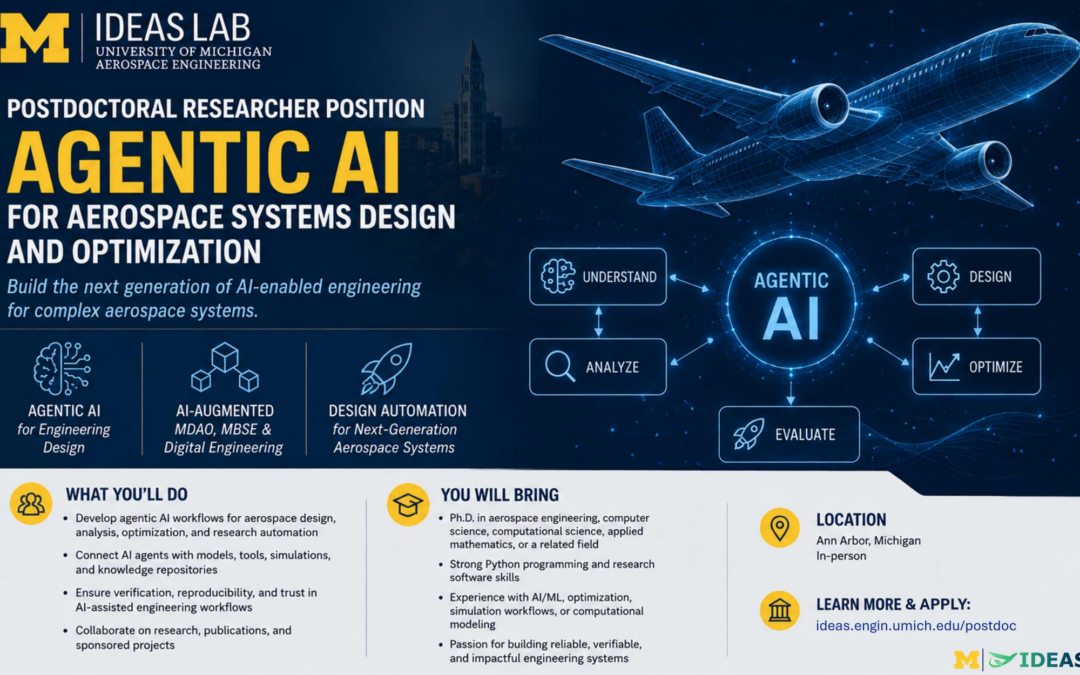
The Integrated Design of Efficient Aerospace Systems Laboratory (IDEAS Lab), part of the Department of Aerospace Engineering at the University of Michigan, is seeking a highly motivated Postdoctoral Researcher to help develop a next-generation agentic AI framework for aerospace systems research. This position is available immediately and will remain open until filled.
This position will focus on building AI-assisted, verifiable computational workflows that connect aircraft design models, multidisciplinary design analysis and optimization (MDAO) tools, knowledge repositories, simulation codes, and human expert judgment. The goal is to develop reusable research infrastructure that can translate high-level aerospace research questions into structured, executable, and verifiable computational workflows.
About us: Our lab develops computational methods and digital engineering workflows for the design, optimization, and systems engineering of complex engineered systems. We integrate MDAO, modelbased systems engineering (MBSE), and physics-based and data-driven modeling to produce reusable, traceable, and decision-relevant studies. Learn more about our lab at http://ideas.engin.umich.edu.
Subject areas: Agentic AI; AI-augmented aerospace systems design and engineering; scientific machine learning; and AI applications in MDAO, MBSE, and workflow automation.
Job Description: The successful candidate will lead the development of agentic AI infrastructure for aerospace systems design and analysis. They will build multi-agent and tool-augmented workflows that can interpret research objectives, retrieve relevant information, select models and tools, execute analyses, diagnose errors, verify results, and summarize assumptions and limitations. They will help convert existing design, optimization, and surrogate modeling tools into reusable software components with clear documentation, input-output schemas, and validation checks. They will collaborate closely with graduate students, support sponsored projects, publish journal articles, contribute to proposals, and help establish the lab’s technical foundation for AI-assisted aerospace research.
Key responsibilities include:
• Developing agentic AI workflows for aerospace systems design, analysis, optimization, and research automation.
• Building reusable software infrastructure that connects AI agents with aircraft design models, simulation tools, optimization workflows, knowledge repositories, and verification routines.
• Creating knowledge-retrieval, benchmarking, and verification procedures to assess correctness, reproducibility, traceability, and usefulness of AI-assisted workflows.
• Collaborating with students and researchers to support high-quality software practices, publications, sponsored projects, and proposal development. Position Requirements:
• Ph.D. degree in aerospace engineering, computer science, computational science, applied mathematics, mechanical engineering, or a closely related field.
• Strong programming skills, with proficiency in Python. • Demonstrated experience developing reliable research software, computational workflows, AI/ML systems, or simulation/optimization tools.
• Background in one or more of the following: computational modeling, optimization, simulation workflows, scientific machine learning, or AI agents.
• Familiarity with large language models, agentic AI workflows, tool-calling agents, retrievalaugmented generation, or AI-assisted coding.
• Strong interest in verification, validation, reproducibility, and scientific error checking.
• Ability to work independently in an interdisciplinary research environment.
• Strong written and oral communication skills. • Demonstrated research productivity through publications, software, or research artifacts.
Preferred (Bonus) Qualifications:
• Experience building LLM-enabled or agentic AI systems, such as tool-using agents, RAG systems, workflow automation, or AI-assisted coding/research tools.
• Experience with research software engineering practices, such as testing, packaging, APIs, schemas, documentation, CI/CD, or reproducible workflows.
• Experience with computational design, optimization, surrogate modeling, systems engineering, simulation workflows, or scientific machine learning.
• Familiarity with aerospace design tools or concepts, such as FAST, Aviary, OpenMDAO, OpenVSP, aircraft conceptual/preliminary design, propulsion system modeling, or MBSE/SysML.
• Experience with HPC systems, SLURM, automated job submission, containerization, local/opensource LLM deployment, vector databases, embeddings, or knowledge graphs.
Candidates are not expected to have experience in all preferred areas; applicants with strong expertise in either agentic AI/research software engineering or computational aerospace design, and a demonstrated ability to work across disciplines, are encouraged to apply. Location:
This position is based in Ann Arbor, MI, a vibrant university town that consistently rates as one of the best places to live in the US. The mode of work is in-person.
Application: Interested candidates should email a resume, a detailed statement (max 1 page) explaining how their background and experience align with the job description, the names and contact information of three references, and 2-3 select papers and/or software/project examples relevant to the research topics listed above to Prof. Gökçin Çınar at [email protected] . Applicants should also indicate whether they are currently authorized to work in the United States and whether they would require visa sponsorship now or in the future. Please include “Postdoc Application – Agentic AI – [Your Name]” in the email subject line.
Background Screening: The University of Michigan conducts background checks on all job candidates upon acceptance of a contingent offer and may use a third-party administrator to conduct background checks. Background checks are performed in compliance with the Fair Credit Reporting Act. The University of Michigan is an equal opportunity/affirmative action employer.