Events

- This event has passed.
Ph.D. in Scientific Computing Student Seminars
March 25 @ 12:00 pm - 1:00 pm
Venue: Room 4425, Green Court Building
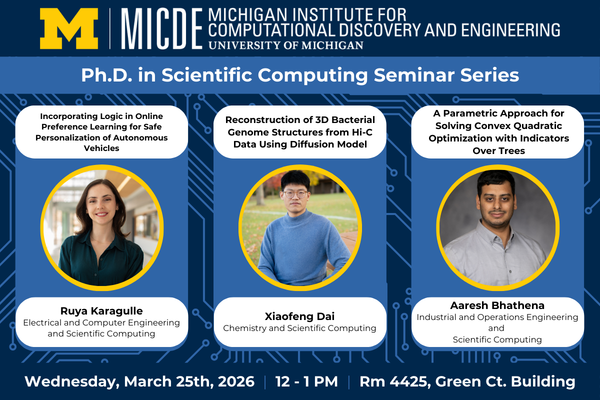
The MICDE PhD Student Seminar Series showcases the research of students in the Ph.D. in Scientific Computing. Lunch will be served. These events are open to the public, but we request that all who plan to attend register in advance. Planned sessions will be canceled if no one signs up to present, and registered attendees will be notified.
If you have any questions, please email [email protected].
A Parametric Approach for Solving Convex Quadratic Optimization with Indicators Over Trees
This talk investigates convex quadratic optimization problems involving n indicator variables, each associated with a continuous variable, particularly focusing on scenarios where the matrix Q defining the quadratic term is positive definite and its sparsity pattern corresponds to the adjacency matrix of a tree graph. We introduce a graph-based dynamic programming algorithm that solves this problem in time and memory complexity of O(n2). Central to our algorithm is a precise parametric characterization of the cost function across various nodes of the graph corresponding to distinct variables. Our computational experiments conducted on both synthetic and real-world datasets demonstrate the superior performance of our proposed algorithm compared to existing algorithms and state-of-the-art mixed-integer optimization solvers.
Aaresh Bhathena (Industrial and Operational Engineering and Scientific Computing)
Aaresh Bhathena is a PhD student in Industrial and Operations Engineering at the University of Michigan, advised by Professor Salar Fattahi. His research focuses on solving optimization problems that arise in machine learning and operations research.
Reconstruction of 3D Bacterial Genome Structures from Hi-C Data Using Diffusion Model
In this talk, I will present a generative framework for reconstructing three-dimensional bacterial genome structures from Hi-C data. Existing methods predominantly yield a single deterministic structure, overlooking the inherent heterogeneity and dynamic nature of chromosome organization. To address this limitation, I applied a conditional latent diffusion model that generates ensembles of genome conformations conditioned on contact frequencies. This project aims to deliver a diffusion-based reconstruction method that provides uncertainty-aware, population-level representations of bacterial genome organization.
Xiaofeng Dai (Chemistry and Scientific Computing)
Xiaofeng’s research focuses on bacterial genome organization. His work integrates quantitative microscopy and data-driven analysis to understand how chromosomes are structured and regulated in bacteria cells.
Incorporating Logic in Online Preference Learning for Safe Personalization of Autonomous Vehicles
Customizing autonomous vehicles to align with user preferences while ensuring safety may significantly impact their adoption. Collecting user preference data by asking a large number of comparison questions can be demanding. In this work, we use active learning along with temporal logic descriptions of constraints to enable safe learning of preferences with a reduced number of questions. We take a Bayesian inference approach combined with Weighted Signal Temporal Logic (WSTL), resulting in a WSTL formula that can rank signals based on user preferences and be used for correct-and-custom-by-construction control synthesis. Our method is practical for formulas and signals with various complexity since we compute STL-related values offline. We provide an upper bound for the number of answers in disagreement with user answers. We demonstrate the performance of our method both on synthetic data and by human subject experiments in an immersive driving simulator. We consider two driving scenarios, one involving a vehicle approaching a pedestrian crossing and the other with an overtake maneuver. Our results over synthetic experiments with ground truth weight valuation show that our query selection algorithm converges faster than random query selection. Human subject study results show an average agreement of 94% with user answers during training, and 79% during validation (which increases to 86% when restricted to high confidence results).
Ruya Karagulle (Electrical and Computer Engineering and Scientific Computing)
Ruya Karagulle is a PhD candidate in the Ozay Group whose research focuses on integrating formal methods and human feedback for safe and personalized control synthesis. Her work has been recognized through multiple fellowship awards, including Rackham Predoctoral Fellowship.