Events

- This event has passed.
Ph.D. in Scientific Computing Student Seminars
April 8 @ 12:00 pm - 1:00 pm
Venue: Room 4425, Green Court Building
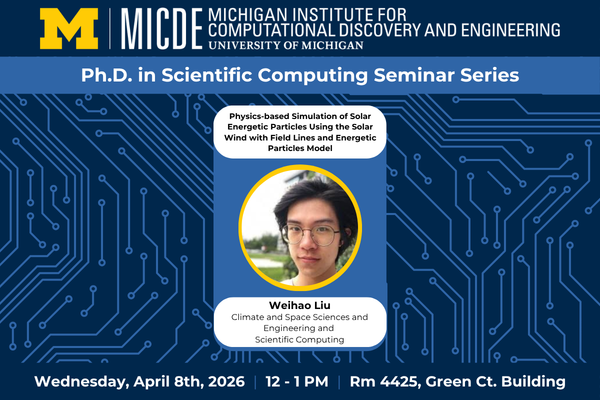
The MICDE PhD Student Seminar Series showcases the research of students in the Ph.D. in Scientific Computing. Lunch will be served. These events are open to the public, but we request that all who plan to attend register in advance. Planned sessions will be canceled if no one signs up to present, and registered attendees will be notified.
If you have any questions, please email [email protected].
Physics-based Simulation of Solar Energetic Particles Using the Solar Wind with Field Lines and Energetic Particles Model
Solar energetic particles (SEPs) can pose hazardous radiation risks to both humans and spacecraft electronics in space. In this talk, we present recent advances in physics-based simulation of solar energetic particles (SEPs) using the Solar Wind with Field Lines and Energetic Particles (SOFIE) model within the Space Weather Modeling Framework. We describe the development of a particle-conserving numerical scheme for particle acceleration and transport, together with a shock-capturing tool for coronal mass ejection-driven shocks, and show their application to one of the historical SEP events with multi-spacecraft comparison. We also discuss SOFIE’s recent evaluation unnder a simulated operational condition at NOAA’s Space Weather Prediction Center, where we demonstrated its ability to deliver SEP forecasts significantly faster than real time, supporting future space weather forecasting and human space exploration.
Weihao Liu (Climate and Space Sciences and Engineering and Scientific Computing)
Weihao Liu is a Ph.D. student in Climate and Space Sciences and Engineering at the University of Michigan. His research focuses on physics-based modeling of solar coronal mass ejections and solar energetic particles, and space weather forecasting, with an emphasis on developing and applying numerical models to understand particle acceleration and transport in the heliosphere.