Events

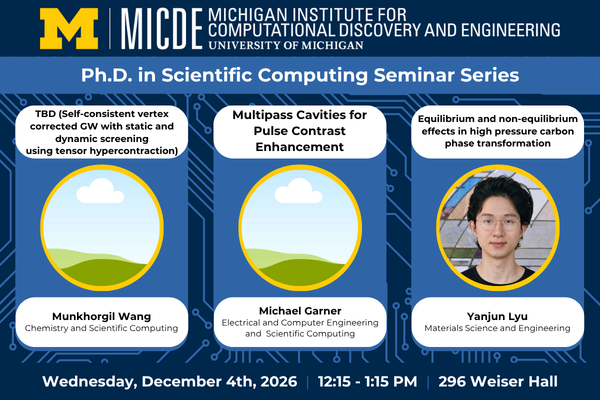
Ph.D. in Scientific Computing Student Seminar
December 4 @ 12:15 pm - 1:15 pm
Venue: 296 Weiser Hall
The MICDE PhD Student Seminar Series showcases the research of students in the Ph.D. in Scientific Computing. Lunch will be served. These events are open to the public, but we request that all who plan to attend register via Sessions in advance. Planned sessions will be canceled if no one signs up to present.
Equilibrium and non-equilibrium effects in high pressure carbon phase transformation
Carbon under extreme thermodynamic conditions (1 to 100 GPa, 1 to 10 kK) is central to planetary science, dynamic compression experiments, and the high-pressure synthesis of functional nanomaterials. However, experimentally probing the transformation pathways and liquid phase behavior of carbon remains exceptionally difficult due to picosecond timescales, extreme temperatures, and severe sample degradation. While first-principles quantum calculations are strictly bounded by temporal and spatial limits, and empirical potentials often lack physical accuracy across complex bonding regimes, machine-learned interatomic potentials enable quantum-accurate molecular dynamics at previously inaccessible length and timescales.
In the bulk limit, large-scale atomistic simulations allow us to systematically determine the carbon melt line up to 100 GPa and map the graphite-diamond coexistence boundary. We demonstrate that the coexisting liquid evolves continuously without evidence of a first-order liquid-liquid transition. Orientation-resolved interface tracking reveals that graphite basal planes form an interfacial dewetting layer and melt via a layer-by-layer mechanism, resulting in pronounced kinetic hysteresis. Furthermore, massively parallel non-equilibrium quench trajectories establish a kinetically limiting phase boundary that extends graphite metastability up to approximately 25 GPa. Moving to finite-size regimes, we show how surface curvature and nanoscale confinement depress melting temperatures and alter transformation kinetics, dictating the selective nucleation of diamond versus graphitic nano-allotropes. These results resolve longstanding thermodynamic discrepancies in the carbon phase diagram and provide quantitative kinetic bounds to interpret shock-compression experiments and guide nanocarbon synthesis.
Yanjun Lyu (Materials Science and Engineering and Scientific Computing)
Yanjun Lyu is a Ph.D. candidate in Materials Science and Engineering and Scientific Computing, working with Prof. Rebecca Lindsey. His research focuses on developing machine-learned interatomic potentials and high-performance molecular dynamics simulations to investigate carbon phase transformations and nanocarbon synthesis under extreme thermodynamic conditions.
If you have any questions, please email [email protected].
Register to attend