Events

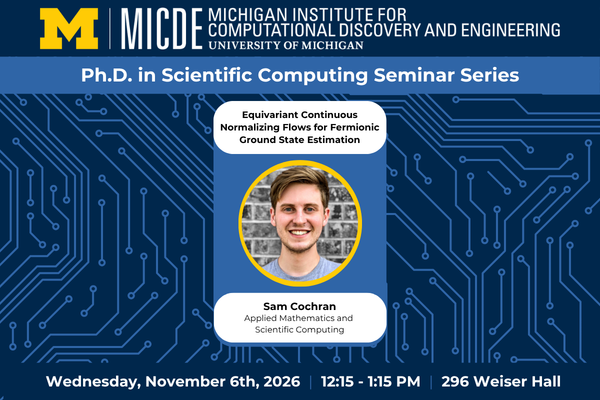
Ph.D. in Scientific Computing Student Seminar
November 6 @ 12:15 pm - 1:15 pm
Venue: 296 Weiser Hall
The MICDE PhD Student Seminar Series showcases the research of students in the Ph.D. in Scientific Computing. Lunch will be served. These events are open to the public, but we request that all who plan to attend register via Sessions in advance. Planned sessions will be canceled if no one signs up to present.
Equivariant Continuous Normalizing Flows for Fermionic Ground State Estimation
A framework for fermionic variational Monte Carlo is introduced in which a continuous normalizing flow refines a fixed antisymmetric base wavefunction. The flow is a permutation-equivariant neural ordinary differential equation, a smooth, topology-preserving map; equivariance preserves the antisymmetry of the base, so the flow can in principle improve any antisymmetric ansatz that can be sampled efficiently. The flow deforms the nodal surface of the base but cannot change its topology, so the base must supply the correct nodal topology. Exact samples from the flow’s Born distribution are obtained by pushing pre-cached base samples through the forward ODE, requiring no Markov chain Monte Carlo at training time. Base samples are generated offline and reused across batches and runs, enabling embarrassingly parallel training across multiple GPUs. Three permutation-equivariant vector field architectures are introduced: Pairwise Deep Sets, FermiNet Vector Fields, and Pairwise Deep Sets Gradient, each balancing expressivity and computational cost differently. In addition, an augmented dynamics formulation is presented, in which the derivatives required for the kinetic energy are co-evolved as ODE state variables, eliminating differentiation through the ODE trajectory and significantly reducing wall-clock time and memory. On harmonically trapped spinless electrons, the flow reaches ground-state energies below configuration interaction with single and double excitations, on par with a FermiNet baseline trained with the same optimizer. Training shows near-ideal strong scaling to 128 NVIDIA A100 GPUs on NERSC’s Perlmutter for the largest systems tested, up to N = 48 particles in three dimensions.
Sam Cochran (Applied Mathematics and Scientific Computing)
Sam is a PhD candidate studying applied mathematics. His work focuses on quantum algorithms, quantum simulation, and machine learning methods for quantum chemistry. He is currently interested in flow based models for ground state estimation problems.
If you have any questions, please email [email protected].
Register to attend