Events

Ph.D. in Scientific Computing Student Seminar
November 20 @ 12:15 pm - 1:15 pm
Venue: 296 Weiser Hall
The MICDE PhD Student Seminar Series showcases the research of students in the Ph.D. in Scientific Computing. Lunch will be served. These events are open to the public, but we request that all who plan to attend register via Sessions in advance. Planned sessions will be canceled if no one signs up to present.
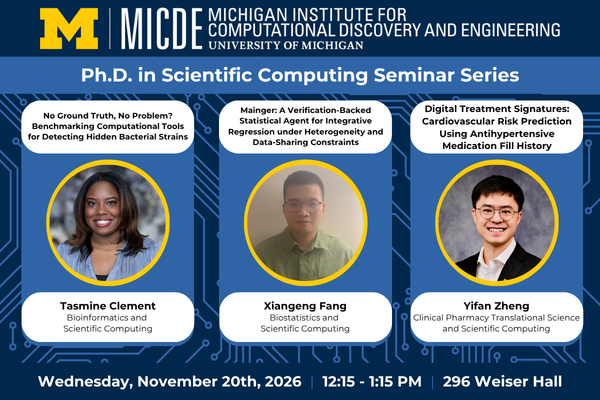
Mainger: A Verification-Backed Statistical Agent for Integrative Regression under Heterogeneity and Data-Sharing Constraints
Integrating external information can sharpen estimation and prediction in small internal studies, but in practice the gain is limited by between-cohort heterogeneity and by restrictions on what data may be shared. We study integrative regression across three access regimes: full sharing, where individual-level data are available from both cohorts; partial sharing, where internal individual-level data and an external coefficient estimate are available; and restricted sharing, where only target-cohort marginal summaries, an external coefficient estimate, and a reference covariance matrix are available. A Mahalanobis-regularized objective unifies ridge regression, distance-based transfer learning, inverse-variance integration, and summary-level regression, while allowing reduced external covariate spaces, covariate shift, and effect-size heterogeneity. Across all three sharing regimes, we establish conditions under which external borrowing improves mean-squared estimation or prediction risk over the corresponding internal-only benchmark. For partial and restricted sharing, we further derive closed-form optimal weights and provide a bias-alignment diagnostic for negative transfer. We embed the framework in Mainger, a verification-backed natural-language agent whose numerical results are produced by validated statistical functions rather than by the language model. Controlled simulations and applications to center-specific kidney-transplant prediction and trans-ethnic polygenic prediction demonstrate stable gains in estimation and prediction, while agent benchmarks demonstrate reliable regime recognition, tool use, and reproducible workflow execution.
Xiangeng Fang (Biostatistics and Scientific Computing)
Xiangeng Fang is a Ph.D. candidate in Biostatistics at the University of Michigan, where his research focuses on statistical machine learning, transfer and continual learning, and reliable AI-assisted analysis.
No Ground Truth, No Problem? Benchmarking Computational Tools for Detecting Hidden Bacterial Strains
Hospital patients often carry multiple strains of the same drug-resistant bacterium, but standard surveillance sequences a single colony and misses the rest. Sequencing whole bacterial populations can recover this hidden diversity, yet real samples offer no ground truth. This talk presents a framework for validating strain-detection tools using synthetic mixtures of known composition, noise-calibrated detection thresholds, and three tools for benchmarking. These results offer general lessons for validating inference tools without ground truth.
Tasmine Clement (Biostatistics and Scientific Computing)
Tasmine’s research uses whole-genome and population sequencing to study how bacteria spread in healthcare facilities, with a focus on building computational tools that help researchers track disease transmission.
Digital Treatment Signatures: Cardiovascular Risk Prediction Using Antihypertensive Medication Fill History
Every pharmacy fill is a time-stamped record of how a patient lives with treatment: when therapy starts, how it is intensified, and when refills come early, late, or stop. Cardiovascular risk models usually reduce this history to a single adherence number, such as the proportion of days covered (PDC), or a yes/no treatment indicator. In this talk, I treat the ordered dispensing timeline as a “digital treatment signature.” Each fill becomes a structured token, and a deep survival model learns from the sequence. Using Michigan Medicine data on adults starting antihypertensive therapy, I test how far each representation of medication history improves prediction of 3-year major adverse cardiovascular events, starting from clinical risk factors and moving to PDC, engineered regimen features, and the full fill sequence. The ordered sequence added discrimination beyond both PDC and the PREVENT equations, using records that health systems already collect.
Yifan Zheng (Clinical Pharmacy Translational Science and Scientific Computing)
Yifan Zheng, PharmD, is a PhD candidate in Clinical Pharmacy Translational Science at the University of Michigan, where he works in Dr. Corey Lester’s MeDS Lab and is also earning an MS in Bioinformatics. His research uses real-world medication data, such as pharmacy fill histories and electronic health records, and applies machine learning and causal inference to predict cardiovascular risk and personalize hypertension treatment.
If you have any questions, please email [email protected].
Register to attend