Events

- This event has passed.
Ph.D. in Scientific Computing Student Seminar
August 11 @ 12:00 pm - 1:00 pm
Venue: Room 4425, Green Court Building
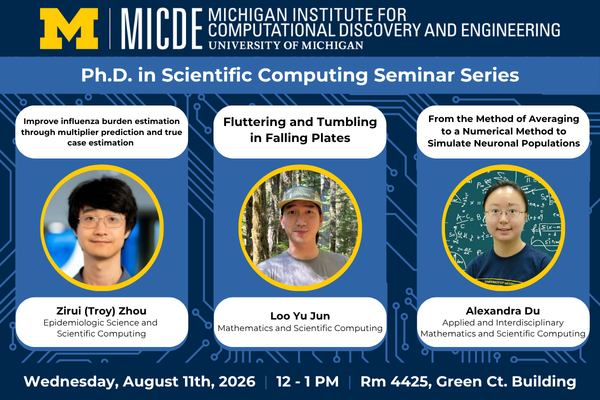
The MICDE PhD Student Seminar Series showcases the research of students in the Ph.D. in Scientific Computing. Lunch will be served. These events are open to the public, but we request that all who plan to attend register in advance. Planned sessions will be canceled if no one signs up to present, and registered attendees will be notified.
If you have any questions, please email [email protected].
Improve influenza burden estimation through multiplier prediction and true case estimation
Influenza infection burden estimation in the US currently relies on multipliers that are not timely updated. This study aims to utilize Michigan Medicine patient records and local longitudinal cohorts to describe and predict next season values for influenza case-to-hospitalization ratios and percent of cases seeking outpatient care using machine learning classification models. We also estimated true number of inpatient and outpatient influenza cases in the capture population of five Michigan Medicine sites, which was validated through scenario simulations using an agent-based model.
Troy Zirui Zhou (Epidemiology and Scientific Computing)
Zhou research involves influenza burden estimation, phylodynamics, and modeling.
Fluttering and Tumbling in Falling Plates
Falling thin bodies are ubiquitous in nature: gliding birds and falling leaves are familiar examples. In this talk, we discuss how fast, low order numerical models can help explain the fundamental physics behind such motions.
Yu Jun Loo (Mathematics and Scientific Computing)
Loo Yu Jun is a PhD candidate in pure mathematics and scientific computing. He works with Professor Silas Alben on developing fast computational methods for bio-locomotion.
From the Method of Averaging to a Numerical Method to Simulate Neuronal Populations
We present a novel numerical algorithm that incorporates phase reduction techniques into Lagrangian particle methods to study population-level behaviors of noisy coupled oscillators. We use elliptical Gaussian basis functions to solve the Fokker-Planck equation that describes the evolution of the probability density function using a score-based approach. We propose the shrinkage of particles based on phase reduction, which takes advantage of the traditional approach that simplifies periodic dynamical systems. At the same time, we preserve the structure of the possibly high-dimensional state space and effectively avoid oversimplification. Our method reduces the number of particles and accelerates the particle updating process, thereby achieving higher computational efficiency.
Alexandra Du (Applied and Interdisciplinary Mathematics and Scientific Computing)
Alexandra obtained her bachelor’s degree from Oberlin College. She works with Professor Daniel Forger in the math department. Her research focuses on applied dynamical systems and computational neuroscience.