Events

Ph.D. in Scientific Computing Student Seminar
November 13 @ 12:15 pm - 1:15 pm
Venue: 296 Weiser Hall
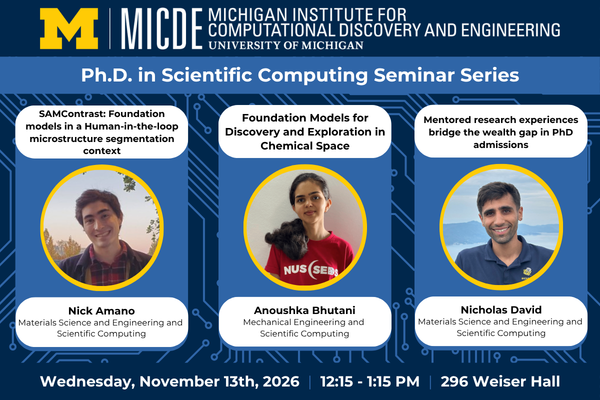
The MICDE PhD Student Seminar Series showcases the research of students in the Ph.D. in Scientific Computing. Lunch will be served. These events are open to the public, but we request that all who plan to attend register via Sessions in advance. Planned sessions will be canceled if no one signs up to present.
Foundation Models for Discovery and Exploration in Chemical Space
This talk presents MIST, a family of molecular foundation models with an order-of-magnitude more parameters and training data than prior works. MIST models predict more than 400 structure-property relationships and demonstrate state-of-the-art performance across diverse benchmarks spanning physiology to electrochemistry. We illustrate MIST’s capacity to solve real-world problems across chemical space, from multiobjective electrolyte screening to olfactory perception mapping. The talk covers our systematic application of mechanistic interpretability methods to uncover generalizable scientific concepts learned by the model, revealing how the models encode chemical knowledge. We introduce innovations in the training methodology, including hyperparameter-penalized neural scaling laws that reduce model development computational costs by an order of magnitude. Together, these methods and findings represent significant progress toward accelerating materials discovery using foundation models.
Anoushka Bhutani (Mechanical Engineering and Scientific Computing)
Anoushka Bhutani is a PhD candidate in Mechanical Engineering and Scientific Computing working at the intersection of chemistry and machine learning. She works on developing molecular foundation models to accelerate materials discovery with an interest in developing model interpretability methods for scientific applications.
SAMContrast: Foundation models in a Human-in-the-loop microstructure segmentation context
Quantitative image segmentation is essential for analyzing solid phase microstructures during solidification and processing, primary drivers of material performance. General image foundation models, such as Meta’s second iteration of the Segment Anything Model (SAM 2), struggle with the specialized details of microstructural image data. Training specialized machine learning models for microstructural tasks has required detailed and time consuming manual label curation. This research introduces SAMContrast, a framework that leverages rough, zero-shot outputs from SAM 2 to minimize annotation requirements for training a supervised segmentation model. While SAM 2 may produce insufficient results for direct analysis, a subset of its more accurate segmentations of frames can capture the representative features necessary to guide a supervised learner. By utilizing these initial outputs as training data, we trained a specialized generative model capable of high-fidelity analysis from minimal human-annotated input. We demonstrate the efficacy of this method by detecting low-contrast liquid-Al solidification fronts during eutectic Al-Si direction solidification optical videos. The results show significant improvements in segmentation accuracy and enable meaningful microstructural characterization.
Nicholas Amano (Materials Science and Engineering and Scientific Computing)
He is a 4th year doctoral candidate in Materials Science and Engineering working with Elizabeth Holm on advanced structural materails characterization using data-driven techniques and computer vision.
Mentored research experiences bridge the wealth gap in PhD admissions
PhD admissions decide which aspiring researchers gain access to scientific careers. Socioeconomic background has long shaped academic opportunity, influencing entry into elite undergraduate institutions and the professorate, yet its role in doctoral admissions has remained difficult to measure directly. Here we analyze 52,888 PhD applications submitted between 2013-2023 to one of the largest PhD-granting institutions in the United States, combining applicant credentials and recommendation letters with faculty evaluations and socioeconomic measures—including family home equity, parental education and reported financial hardship. We uncover a distinct wealth gap in doctoral admissions: applicants from higher socioeconomic backgrounds are both more likely to apply and to be admitted. Although faculty do not explicitly evaluate wealth, socioeconomic advantage systematically propagates through key admissions criteria including grades, test scores and undergraduate institutional prestige. In contrast, we find that mentored research experiences, and their resulting recommendations, provide an influential and wealth-agnostic signal of research potential. Expanding access to scientific training therefore calls for a stronger ecosystem of mentored research experiences, broader faculty participation in mentoring, and earlier encouragement for aspiring scholars to seek out these opportunities.
Nicholas David (Materials Science and Engineering and Scientific Computing)
Nicholas David is a PhD candidate of Materials Science and Engineering and Scientific computing working on data-driven inorganic materials discovery and computational social science under advisor, Professor Wenhao Sun. He graduated from Carnegie Mellon University in 2022 with a Bachelor’s degree in Materials Science and Engineering and Applied Physics.
If you have any questions, please email [email protected].
Register to attend